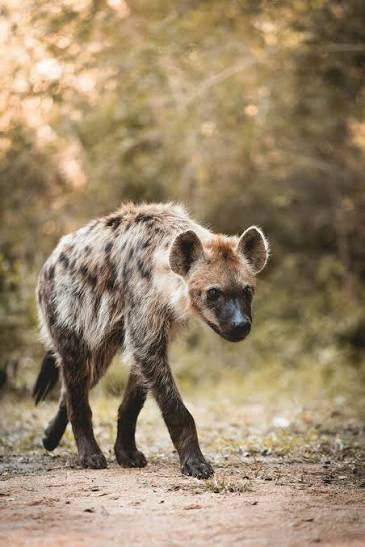
Read the facts about hyenas below :
1. Surprising Evolutionary Lineage: Despite looking remarkably like large dogs, hyenas are evolutionarily more closely related to felines and mongooses than to canines. They belong to their own unique biological family, Hyaenidae, which falls under the suborder Feliformia (cat-like carnivores). The largest species, the spotted hyena, can reach a heavy weight of up to 85 kg, with females consistently outgrowing the males. Their bodies are supported by heavily built front shoulders and a robust neck designed to carry substantial skeletal loads. This physical structure gives them the immense strength needed to drag heavy carcasses away from rival predators. Their distinct evolutionary path has equipped them with specialized traits that allow them to thrive in competitive ecosystems alongside large cats like lions and leopards.
2. Complex Matriarchal Clans: Spotted hyenas live in highly structured, sophisticated societies known as clans, which can include up to 80 individual members. Unlike most mammalian carnivores, hyena society is strictly matriarchal, meaning females hold all the dominant positions and outrank every single male. Even the lowest-ranking female in the clan enjoys a higher social standing and better food access than the highest-ranking male. Social status within the clan is linear and hereditary, with daughters directly inheriting their mother's exact rank in the hierarchy. This complex social structure requires high levels of intelligence, as individuals must constantly monitor shifting alliances, bonds, and status indicators. To maintain order and coordination, clan members frequently engage in elaborate greeting rituals to reinforce social bonds and reduce internal friction.
3. Bone-Crushing Bite Power: The jaws of a hyena are legendary for their devastating mechanical power, capable of exerting an incredible force of over 9,000 Newtons. This jaw strength is supported by a specialized skull shape featuring a prominent sagittal crest, which provides a massive attachment area for powerful biting muscles. This evolutionary design allows them to effortlessly crack open the thickest leg bones of elephants, giraffes, and buffaloes to access the nutrient-rich marrow inside. While other predators leave skeletal remains behind, a feeding hyena pack can reduce a large carcass to a dark stain on the ground within minutes. This ability to consume bones gives them a massive survival advantage, allowing them to exploit food sources that are completely unusable to any other mammalian carnivores.
4. The Meaning of the Laugh: The iconic "laugh" or giggle of the spotted hyena is one of the most misunderstood vocalizations in the natural world. It is not an expression of amusement or joy, but rather a high-pitched sound produced when an individual is experiencing intense frustration, fear, or social stress. This sound is most frequently heard at kill sites when hyenas are competing with one another for meat or being bullied by dominant clan members. The pitch and note variations of the giggle actually convey specific data about the caller's age, social status, and identity to nearby clan mates. By listening to the vocalization, neighboring hyenas can determine whether a younger or older individual is in distress and react accordingly. It is a vital tool for managing the chaotic social dynamics of a large group during high-stress feeding events.
5. Diverse Family Species: The modern hyena family is divided into four distinct surviving species, each filling a very specific ecological niche across Africa and Asia. The famous spotted hyena is the largest and most vocal variety, widely distributed across the open savannas of sub-Saharan Africa. The brown hyena is uniquely adapted to desert life, sporting a long, shaggy coat and roaming the harsh landscapes of the Kalahari and Namib deserts. The striped hyena is smaller, covered in dark vertical bars, and occupies a massive geographic range stretching from North Africa through the Middle East into India. The final species is the aardwolf, a highly specialized, delicate insectivore that feeds almost exclusively on termites using a long, sticky tongue. Each of these species represents a completely different survival strategy within the same evolutionary family line.
6. Unique Female Anatomy: Female spotted hyenas possess a highly unusual, masculinized anatomy that makes them virtually indistinguishable from males at a distance. They feature a specialized pseudo-penis formed by an elongated clitoris, alongside fused labia that mimic a male scrotal sac. This unique anatomical structure is accompanied by exceptionally high levels of androgen hormones during development, which contributes to their large size and aggressive behavior. The pseudo-penis is a fully functional organ through which the female must urinate, mate, and give birth to her offspring. Giving birth through this narrow canal is incredibly dangerous, making first-time deliveries one of the highest causes of mortality for young female hyenas. This extreme biological trait is thought to have evolved to help females maintain social dominance and control over food resources in highly competitive environments.
7. Incredible High-Endurance Running: While big cats rely on explosive short sprints, hyenas are built as elite endurance athletes capable of chasing prey over long distances. Their large lungs and massive hearts give them a highly efficient cardiovascular system that resists fatigue during prolonged tracking. Hyenas can maintain a steady, loping pursuit speed of 50 km/h for several kilometers without showing signs of exhaustion. This relentless stamina allows them to slowly wear down large herbivores like wildebeest and zebras until the targets drop from sheer fatigue. During a hunt, they will select a single individual from a herd and pursue it methodically, ignoring other animals that cross their path. This high-endurance hunting strategy ensures a very high success rate, often outperforming the ambush success rates of lions and leopards.
8. Long-Distance Acoustic Whoops: The African night sky is frequently filled with the haunting, resonant "whoop" call of the spotted hyena, a powerful long-distance vocalization. Produced by a flexible vocal apparatus, this deep sound starts low and rises to a high pitch, carrying clearly across open savannas for up to 5 km. Hyenas use this specific call to communicate critical information across their vast territories without needing to travel. A single whoop can signal a call for reinforcement against lions, announce a successful kill, or help a scattered clan gather. Each individual hyena has a completely unique acoustic signature to its whoop, allowing clan mates to instantly identify exactly who is calling. This vocal recognition system keeps the clan tightly connected and organized across miles of dark, dangerous wilderness.
9. Ultimate Waste-Free Digestion: As highly specialized carnivores, hyenas possess an incredibly potent digestive system designed to squeeze every ounce of nutrition from a carcass. Their stomachs secrete highly concentrated hydrochloric acid that can dissolve thick bones, horns, hooves, and even the toughest animal hides. Because they digest the massive amounts of calcium found in bones, their calcified droppings dry into a distinct, bright white powder. This efficient digestion ensures that almost nothing goes to waste, allowing hyenas to extract energy from old carcasses that other predators have abandoned. It also plays a vital role in cleaning the ecosystem, preventing the spread of dangerous diseases like anthrax by removing rotting remains. Their specialized internal chemistry makes them the ultimate cleanup crew of the African wilderness.
10. Accomplished Apex Hunters: For decades, popular media painted hyenas as cowardly, simple scavengers that relied entirely on stealing kills from lions. However, modern wildlife biology has revealed that spotted hyenas are incredibly successful apex predators that hunt up to 95% of their own food. They are versatile hunters that can tackle a wide range of prey, from small birds and hares to massive elands and buffaloes. In fact, the dynamic between lions and hyenas is often reversed, with lions regularly tracking the sounds of hunting hyenas to steal their freshly killed prey. Hyenas only resort to heavy scavenging when environmental conditions are poor or when an easy meal presents itself. Their predatory skills, combined with their intelligence, place them firmly at the top of the food chain as dominant hunters.
11. Strategic Pack Tactics: When targeting large, dangerous prey animals, spotted hyena clans display remarkable levels of team coordination and strategic planning. They use visual signals and vocal cues to organize their formation, carefully analyzing a herd to identify weak, old, or young individuals. Once a target is selected, different clan members take turns leading the chase to conserve energy while keeping constant pressure on the prey. Other hyenas will fan out to block escape routes or prevent the rest of the herd from returning to defend the target. This calculated teamwork allows them to safely bring down animals that are many times their own physical size. Their cooperative hunting strategies require a deep understanding of group dynamics and real-time problem-solving out on the open plains.
12. Superb Nocturnal Adaptation: Hyenas perform the vast majority of their social activities and complex hunting maneuvers under the cover of total darkness. Their eyes are highly adapted to low-light conditions, featuring a specialized light-reflecting tissue layer behind the retina called the tapetum lucidum. This biological structure acts like an internal mirror, bouncing light back through the retinal cells to double their visual sensitivity. This adaptation causes their eyes to flash with a bright, intense white or golden glow when caught in artificial light beams at night. This superior night vision gives them a massive tactical advantage over diurnal prey animals that struggle to navigate the dark plains. Their acute hearing and highly sensitive sense of smell complement this vision, allowing them to map out their environment in pitch-black conditions.
13. High-Capacity Endurance Organs: A close examination of a hyena's internal anatomy reveals an organ system optimized perfectly for high-performance endurance. A hyena's heart is exceptionally large relative to its body size, making up roughly one percent of its total body mass, which is twice the proportion found in a lion. This massive pump allows for rapid oxygenation of muscle tissues during long, exhausting pursuits across rugged terrain. Their blood also contains a high concentration of hemoglobin, allowing them to sustain high physical exertion without suffering from quick lactic acid buildup. This biological investment in cardiovascular power means a hyena can keep running long after a big cat's muscles have completely given out. It is a masterpiece of evolutionary design that favors relentless stamina over brief, explosive strength.
14. Advanced Cub Development: Unlike many carnivores whose young are born helpless, hyena cubs enter the world in an remarkably advanced state of physical development. Spotted hyena litters, usually consisting of twins, are born with their eyes wide open, fully alert, and possessing a set of sharp incisor teeth. Within hours of birth, these precocious cubs can walk and will actively fight one another to establish a dominant hierarchy within the den. The mother raises her young in a communal den site, though she will only nurse her own specific offspring. Hyena milk is exceptionally rich, boasting the highest protein and fat content of any terrestrial carnivore, allowing cubs to survive for days between feedings. Cubs remain dependent on this highly nutritious milk for up to 18 months before they are fully mature enough to join hunts.
15. Pungent Chemical Butter Signposts: To manage their vast territories without constant physical conflict, hyenas utilize a highly sophisticated system of chemical scent marking. They possess specialized anal pouches that produce a thick, yellowish-white paste commonly referred to by researchers as "hyena butter." A hyena will walk over tall stalks of grass, everted its pouch, and smear this strong-smelling paste onto the stems along territory borders. This chemical signature carries a wealth of data, informing passing animals of the marker's identity, sex, clan affiliation, and exact time of passage. Clan members will regularly visit these communal latrines and marking stations to refresh the scent boundaries. This continuous chemical broadcasting system helps minimize direct, costly territorial battles with rival clans by maintaining clear, readable boundaries.
16. The Solitary Scavenger Varieties: While the spotted hyena is famous for its loud, highly social lifestyle, its close relatives, the striped and brown hyenas, lead completely different lives. These two species are primarily solitary, quiet wanderers that spend their nights foraging alone across large, arid landscapes. They rely heavily on their exceptional sense of smell to locate old carcasses, dried bones, and wild fruits over vast distances. Because they do not have the backup of a large clan, they are generally timid and will quickly back down if confronted by other predators. Their social structures are limited to small, loose family groups that share a territory but rarely forage together. These quieter species showcase the incredible diversity within the Hyaenidae family, proving that cooperation is just one of many successful survival strategies.
17. A Rich Vocal Vocabulary: Spotted hyenas are among the most vocal mammals in the wilderness, utilizing a rich acoustic library to maintain their complex social networks. Beyond the famous giggle and whoop, they emit a diverse range of groans, soft grunts, deep rumbles, and cow-like lows. Each specific sound is tied to a distinct emotional state or social message, such as establishing submission to a matriarch or coordinating group attacks. When a clan gathers to defend their food from a pride of lions, their vocalizations merge into an intense, chaotic chorus that can be heard for miles. This continuous acoustic signaling allows individuals to stay informed about changing situations without needing direct visual contact in thick bush. It is a highly advanced communication system that reflects their complex social lives.
18. Severe Persecution Outside Reserves: One of the most critical challenges facing modern hyena conservation is the widespread negative perception that fuels intense human conflict. Outside protected national parks, hyenas face severe persecution from farmers who view them as a constant threat to livestock. They are frequently targeted with indiscriminate wire snares, high-voltage traps, and carcasses laced with deadly agricultural poisons. Entire clans can be completely wiped out in a single night by a poisoned carcass left out near a village boundary. Additionally, historical myths and cultural folklore often paint them as dark, malicious creatures, making it difficult to generate public support for their protection. True conservation requires shifting these cultural perspectives and helping local communities implement predator-proof livestock corrals to reduce economic losses.
19. Sloping Gaits and Tireless Movement: A hyena's unique physical silhouette is defined by a distinct sloping posture, caused by forelegs that are notably longer than their hind legs. This structural design gives them a clumsy, rocking appearance when walking, but it is actually a highly efficient mechanism for long-distance travel. This specific anatomy lowers their center of gravity and reduces the energy required to propel their weight forward over rolling terrain. Their feet feature large, blunt, non-retractable claws that act like running spikes, providing excellent traction on loose sand and mud. Unlike cats, they cannot retract these claws, meaning they are worn down naturally by continuous contact with the hard earth. This specialized physical build allows them to effortlessly patrol tens of kilometers every single night in search of food.
20. Critical Ecosystem Conservation: Hyenas are currently facing an unprecedented survival crisis as human populations expand across the African continent, fragmenting their historic ranges. The primary drivers of their decline are habitat loss, loss of natural prey species, and direct retaliation from livestock owners. As vast savannas are converted into agricultural fields, hyenas are forced into closer proximity with humans, leading to increased conflict. However, losing these predators can have devastating effects on an ecosystem, as they are essential for maintaining healthy environments. By removing rotting meat and consuming diseased carcasses, they act as a vital shield against major outbreaks of infectious diseases. Protecting these misunderstood carnivores requires international funding, community education, and the creation of safe wildlife corridors between fragmented parks.