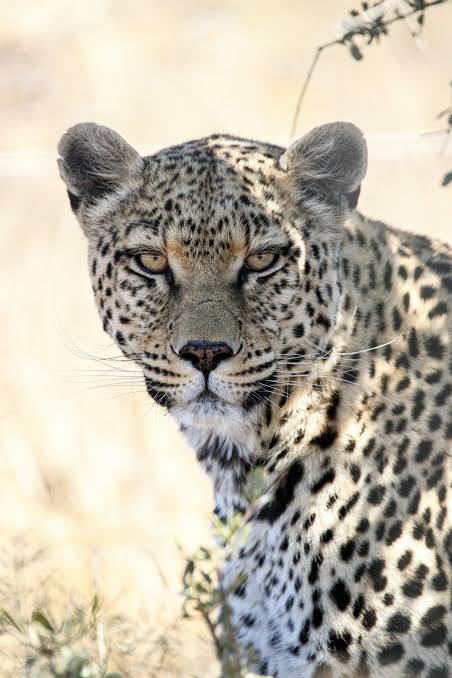
Read the facts about leopards below :
1. Most Adaptable Big Cats: Leopards hold the undisputed title of being the most geographically widespread species among all large wild felines on Earth. An adult male leopard can reach a maximum weight of up to 90 kg, making it smaller than a lion or tiger but a truly formidable presence in its natural habitat. This highly compact body mass is supported by a dense skeletal structure and heavy muscle layers that provide incredible power-to-weight strength. Their physical build allows them to survive in an astonishing variety of ecosystems, ranging from desert edges and rugged mountains to dense tropical rainforests. However, this physical build varies across different ecosystems, with open savanna varieties being notably larger than coastal or forest ones. Sadly, maintaining even these smaller bodies requires stable populations of small-to-medium prey animals. As ecosystems shrink due to human encroachment, these resilient giants struggle more and more to find the space and resources necessary to support their physical frames.
2. Unmatched Tree Climbers: Unlike many other big cats, leopards absolutely love the trees and are exceptionally strong climbers. They routinely rest in branches, raise their cubs in forks, and hoist heavy prey carcasses off the ground to keep them safe from scavengers. It is not uncommon to see a leopard draped comfortably over a high branch, keeping its limbs dangling exposed while resting for hours during the day. Their powerful shoulders and specialized retractable claws make them highly efficient in the canopy, allowing them to climb vertical trunks effortlessly. They have been recorded pulling carcasses weighing more than themselves up into branches that span several meters above the ground. Furthermore, leopards will actively hunt arboreal prey, turning a high tree branch into a trap for monkeys or roosting birds. This unique reliance on arboreal habits highlights how deeply connected they are to healthy, tree-rich forest and woodland systems across Africa and Asia.
3. Impressive Running Speeds: Despite their stocky build and muscular shoulders, leopards are capable of unleashing incredible short bursts of speed reaching up to 58 km/h. This rapid acceleration is essential because they do not possess the stamina for long-distance endurance chases like wild dogs or cheetahs. Instead, they rely on heavy muscle fibers in their hind legs to launch explosive charges from close proximity to their targets. Their heavy paws grip the earth firmly, providing maximum traction as they propel their compact bodies forward during an ambush. This sprinting capability is usually limited to short distances of just a few dozen meters before the animal tires out. If the initial rush fails to secure the prey, the leopard will typically abandon the chase to conserve vital energy. The combination of stealthy stalking and sudden, terrifying speed makes them highly efficient killers when conditions are just right.
4. Unique Rosette Patterns: The iconic spotted pattern found on a leopard's coat functions exactly like a human fingerprint because no two individuals share the same design. These dark circular markings, called rosettes, vary in width, spacing, length, and overall arrangement from one side of the cat's body to the other. Interestingly, these distinct markings are not merely present on the fur layer itself but are actually pigmented directly onto the leopard's skin underneath. This means that even if a leopard were to be completely shaved, its unique rosette patterns would still be fully visible on its bare hide. The primary purpose of this striking coat pattern is disruptive coloration, which breaks up the animal's silhouette against natural backgrounds. In the dappled light of dense forests, acacia trees, and moving shadows, these rosettes render the predator almost completely invisible to unsuspecting prey. This evolutionary design is a masterpiece of natural camouflage that allows them to blend flawlessly into their native ecosystems.
5. Diverse Subspecies: The leopard species is divided into nine distinct subspecies, each uniquely adapted to the specific environmental pressures of its geographic region. The African leopard is the most numerous variety, primarily roaming the diverse landscapes of Sub-Saharan Africa. In contrast, the Amur leopard is built for extreme cold, sporting a thicker coat and a paler frame to survive freezing Russian winters. The Javan leopard is critically endangered, possessing a highly specialized frame ideal for navigating the dense, tropical jungles of Java. Other recognized varieties include the Indian leopard, Arabian leopard, and the Persian leopard, each facing distinct survival challenges in the modern era. Each of these subspecies represents a critical branch of evolutionary history that faces distinct conservation challenges in the modern era. Protecting this genetic diversity requires international cooperation and customized conservation strategies tailored to each region's specific socio-economic realities.
6. Communication Via Ears and Tails: Leopards utilize a sophisticated system of visual communication, and their ears and tails play a vital role in conveying messages to their cubs and rivals. If you look closely at the back of a leopard's ears, you will notice prominent, bright white spots surrounded by dark black fur. These distinct markings are often referred to as "flash spots" or "false eyespots" and serve a highly functional purpose in the wild. When a mother leopard senses danger while leading her cubs through dense brush, she will flatten her ears completely forward or flash them, while using the white underside of her tail tip as a guiding beacon. The young cubs, walking closely behind her, immediately spot these highly visible white targets and know exactly how to react to the signal. Depending on the ear position, the cubs understand whether they need to freeze, hide in the undergrowth, or follow their mother closely. This silent, visual language allows the family group to stay coordinated without making sounds that could alert dangerous predators or scare away prey.
7. Incredible Jumping Power: The physical agility of a leopard is truly astounding, particularly when it comes to their vertical and horizontal leaping capabilities. Thanks to highly developed muscle structures in their hind limbs, leopards can jump up to 3 meters straight up into the air. This extraordinary vertical leap allows them to snatch birds out of mid-air or ambush prey animals seeking refuge on low tree branches. Horizontally, they can clear distances of up to 6 meters in a single bound, allowing them to close gaps instantly. This jumping ability is heavily utilized during hunts, enabling them to leap across wide ravines or rushing streams to surprise their targets. It also serves as a critical defense mechanism, allowing them to escape danger or navigate highly rugged, broken terrain effortlessly. The sheer power generated by their legs ensures that very few natural obstacles can successfully hinder a leopard's movement.
8. A Unique Sawing Call: The vocalization of an adult leopard is one of the most distinctive and unique sounds in the entire animal kingdom. Produced by a specialized larynx with flexible vocal cords, this deep, rasping sound can travel through dense forest canopies up to several kilometers away. Leopards use this booming vocalization to proclaim their territory, warn off potential intruders, and locate distant mates during breeding seasons. The sound waves generated are highly recognizable because they sound exactly like a hand saw cutting through a rough wooden plank. This harsh sawing sound can penetrate solid objects like thick vegetation and can actually warn competing predators to stay clear of the area. When a leopard calls in close proximity, the acoustic vibration is felt physically by anyone standing nearby. This vocal power establishes their dominance over the landscape without the immediate need for physical combat with rival leopards.
9. Diverse Dietary Capacity: As opportunistic carnivores with exceptionally flexible energy requirements, leopards possess a truly massive dietary capacity when food is readily available. A hungry leopard can consume a massive portion of fresh meat in a single night after successfully bringing down prey. This versatile hunting behavior is an evolutionary adaptation to the unpredictable nature of hunting in wild environments, where competition from lions and hyenas is fierce. After consuming a portion of a meal, a leopard will immediately hoist the remains of the carcass up into a tree to protect it from scavengers. They will actively cache the leftover meat high in the branches, returning to it over several days to feed in peace. The leopard will continue to return to this tree site to feed until the entire carcass is stripped completely bare. This cycle of caching and resting means a single successful hunt can sustain a leopard for over a week of resting.
10. Strictly Solitary Lifestyles: Unlike lions, which live in highly social family groups called prides, leopards are strictly solitary animals that prefer to live alone. Except for the mandatory bond between a mother and her growing cubs, adult leopards spend the vast majority of their lives in isolation. They maintain expansive home ranges that they patrol regularly to ensure no other individuals of the same sex intrude. A single male's territory is typically very large and will often overlap with the smaller territories of several adult females. They avoid accidental encounters with neighboring leopards by reading scent signs left behind on trees and rocks along border pathways. When two adult males do happen to cross paths, it can result in vicious, bloody conflicts over territorial rights. This solitary nature requires them to be completely self-reliant, as an injury sustained during a fight or a hunt can easily lead to starvation.
11. Masters of Stealthy Ambush: Leopards are apex predators that rely almost entirely on supreme stealth and ambush tactics rather than chasing down prey over distances. Their rosetted coats blend seamlessly into the shadows, allowing them to creep incredibly close to their targets without being noticed. They will slowly stalk an animal from behind or from the side, moving with absolute silence through dry leaves and twigs. Once they manage to get within a critical striking distance of about 5 to 10 meters, they launch their attack. They use their immense weight to slam into the prey, knocking it off balance and pinning it to the ground. A precise bite is then delivered to the throat or the back of the neck to crush the windpipe or spinal cord. Because this process requires immense precision, only a fraction of their hunting attempts ends in a successful kill.
12. Exceptional Night Vision: Leopards do the vast majority of their hunting during the night because their eyes are highly adapted to low-light conditions. Their nocturnal vision is estimated to be six times better than that of an average human being, giving them an advantage. This clarity is made possible by a specialized layer of tissue behind the retina called the tapetum lucidum. This biological structure acts like an internal mirror, reflecting light back through the retina to maximize every photon available. It is also the reason why a leopard's eyes seem to glow with a brilliant greenish-yellow hue when struck by artificial light. Hunting in the pitch black allows them to use the cover of darkness to approach alert prey animals more easily. Their whiskers also assist in the dark, gathering tactile information about the immediate surroundings as they move through dense brush.
13. Specialized Sandpaper Tongues: A look at a leopard's tongue reveals a fascinating biological tool covered in sharp, backward-facing projections called papillae. These rigid structures give the tongue an incredibly rough texture, closely resembling very coarse, industrial-grade sandpaper. This design serves a vital purpose during feeding, allowing the leopard to rasp meat directly away from the bones of its prey. By licking a carcass repeatedly, the sharp papillae can strip off every single shred of muscle tissue, ensuring nothing goes to waste. It is said that a leopard could easily lick the paint right off a brick wall or draw blood from human skin with a few strokes. Additionally, this rough tongue acts as a natural comb during grooming sessions, removing loose fur, dirt, and parasites from their coats. This specialized anatomy showcases how perfectly adapted every part of the leopard's body is for a purely carnivorous lifestyle.
14. Vulnerable Cub Development: Leopard cubs enter the world in an incredibly vulnerable state, being born completely blind and entirely dependent on their mothers. A typical litter consists of two to three cubs, born in a well-hidden den site like a cave, thick rocky crevice, or hollow tree. Because they cannot see for the first week or two of life, they rely entirely on scent and touch to navigate. The mother leopard must remain highly vigilant, staying close to the den to nurse them while protecting them from predators like lions and hyenas. Male leopards play absolutely no role in raising offspring and may even kill cubs to force the female into mating again. As a result, the mother must balance hunting for food with guarding her vulnerable young from these internal threats. By the time they reach three months old, the cubs begin accompanying her on hunts to learn survival skills.
15. Sophisticated Scent Marking: To maintain their solitary lifestyle without constant physical fighting, leopards utilize a highly advanced system of chemical communication. They possess specialized scent glands located near the base of their tails, between their toes, and around their faces. Leopards will spray a mixture of urine and scent gland secretions high up onto tree trunks and bushes along paths. This fluid carries a distinct chemical signature that informs other leopards of the individual's identity, sex, and reproductive status. They also use their heavy claws to leave deep scratch marks on tree bark, providing a permanent visual boundary marker. Neighboring leopards carefully sniff these marking stations to determine exactly how recently the territory owner passed through the area. This chemical messaging system helps minimize direct confrontations, allowing individuals to share a landscape while maintaining peaceful boundaries.
16. The Truth About Black Panthers: Contrary to popular belief, black panthers are not a distinct subspecies of big cat, nor are they a type of albino. Instead, their striking dark fur and dark eyes are caused by a rare genetic mutation known as melanism. This condition triggers an overproduction of dark pigments in the fur while leaving the underlying rosette patterns fully intact under certain lights. In the wild, this mutation is highly regional, occurring frequently in the dense, tropical rainforests of Southeast Asia where dark coats offer excellent concealment. Because a dark coat enhances natural camouflage in deep shade, these individuals thrive immensely to hunt and survive easily to adulthood. Almost all black panthers seen in zoos today are descendants of specific bloodlines where melanism is highly expressed. To maintain this striking look, captive breeders often track these traits closely, though wild melanistic leopards are perfectly natural evolutionary responses to dark habitats.
17. Intimate Communication Signals: While leopards are famous for their terrifying sawing calls and aggressive growls, they also possess remarkably gentle vocalizations used for close contact. When comfortable or interacting closely, leopards can produce quiet purring sounds, soft chuffs, and low gurgles. These expressions are produced by vibrating air softly through the vocal structures while keeping the mouth closed. It results in a low-frequency, comforting vibration that is used exclusively as a friendly, non-threatening greeting. Leopards will emit these soft sounds at one another when a mother reunites with her cubs or when a male and female approach for mating. It serves to de-escalate tension between these powerful predators, signaling that the individual comes with peaceful intentions. In captive environments, leopards will frequently interact softly with handlers they recognize and trust as a sign of comfort. This soft vocalization offers a glimpse into the gentler, more social side of an otherwise fiercely independent and solitary predator.
18. Extinction Threats in the Wild: One of the most heartbreaking paradoxes of modern leopard conservation is that several subspecies are on the absolute brink of total extinction. Experts estimate that there are fewer than one hundred Amur leopards remaining across their entire natural Russian and Chinese range. Meanwhile, the Arabian leopard faces an equally critical crisis, with tiny, fragmented populations hanging on in isolated mountain ranges. Many of these critically endangered animals live in heavily degraded environments, completely disconnected from large, contiguous wildlife corridors. Large-scale infrastructure projects in parts of Asia also block these animals from migrating safely to find mates or food. This rapid decline of specialized leopard populations underscores the urgent need for international protection. True conservation requires protecting the natural habitats where the remaining wild populations can hunt, breed, and roam freely.
19. Retractable Claws For Tree Climbing: The paws of a leopard are magnificent examples of evolutionary engineering, designed perfectly to facilitate vertical climbing and lethal force. The bottom of each paw features thick, soft, leathery pads that absorb shock and cushion the leopard's weight. These fleshy pads spread out slightly when compressed, distributing pressure so the cat can walk across dry twigs and leaves without making a sound. This silent footfall is absolutely critical for an ambush predator that needs to creep within throwing distance of alert prey. Inside these paws are fully retractable claws that measure several centimeters in length when fully extended. The leopard keeps these claws sheathed inside protective pockets of skin while walking to keep them perfectly sharp and prevent them from wearing down on rocks. When scaling trees or striking prey, the claws lock outward, acting like climbing irons to grip bark and hold struggling animals securely.
20. Severe Conservation Threats: Leopards are currently facing an unprecedented survival crisis, with their global populations listed as vulnerable or endangered on international watchlists. The primary driver of this decline is severe habitat destruction caused by logging, industrial agriculture, and human infrastructure development. Leopards have lost large portions of their historical range over the past century, forcing them into tiny islands of wilderness close to human settlements. This fragmentation leads to increased human-wildlife conflict, as hungry cats venture out of depleted forests into farmlands looking for livestock and face retaliatory killing. Additionally, the insatiable demand for leopard skins and bones in traditional black-market trades fuels relentless poaching networks across Africa and Asia. Every single part of the leopard, from its beautifully patterned coat to its teeth, is illegally traded for exorbitant prices. Without aggressive anti-poaching enforcement and habitat restoration efforts, we face the very real possibility of losing these unique cats from many regions forever.