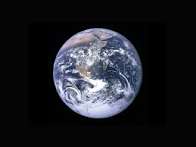
Read the facts about Earth below :
1. Terrestrial Heavyweight: Earth holds the undisputed title of being the largest major terrestrial planet in our solar system. Unlike the gas giants, it is composed primarily of silicate rock and metals, giving it the highest density of any planet in our neighborhood. Its scale and mass allowed it to retain a substantial atmosphere and a hot, active interior. This balanced size presents a perfect celestial baseline for scientists studying planetary habitability, showing how a rocky planet can manage to retain volatile elements and support a thriving biosphere over billions of years.
2. Moderate Temperature Range: Positioned at a comfortable distance from the Sun, Earth maintains an atmospheric blanket to trap thermal energy perfectly. With an atmosphere to regulate heat retention, the planet avoids the violent temperature extremes found elsewhere. During the planetary day, surface temperatures rarely exceed comfortable limits, while nighttime cooling is mitigated by atmospheric insulation. This moderate thermal equilibrium allows liquid water to persist across the globe, driving weather systems and sustaining diverse ecosystems.
3. Balanced Rotational Dynamics: The rotational dynamics of Earth are remarkably stable, creating predictable cycles of night and day. The planet rotates once on its axis roughly every 24 hours while completing an orbit around the Sun every 365.25 days. Because of this rapid spin relative to its orbit, a single solar day is short, preventing prolonged exposure to freezing dark or intense solar heat. This rapid turnover distributes solar energy evenly across the globe, supporting a highly balanced global climate system.
4. Near-Circular Orbital Path: If you track the sun over the course of a year from the surface of Earth, you will witness a highly stable sky. Because Earth's path around the Sun is a near-perfect circle rather than an eccentric oval, the Sun's apparent size remains relatively constant throughout the year. At all points in its orbit, the Sun follows a predictable path across the sky without erratic reversals. This steady celestial movement ensures that seasonal shifts are driven primarily by axial tilt rather than abrupt distance variations.
5. Solitary Companion Status: Unlike planets with zero moons, or gas giants like Jupiter that boast complex networks of dozens of natural satellites, Earth lives with a single, influential companion. It possesses exactly one large moon and no planetary rings whatsoever. Astronomers believe that this massive Moon was formed early in Earth's history from a colossal collision, and its gravitational pull helps stabilize Earth's axial tilt over millions of years, preventing drastic climate shifts.
6. Robust Protective Atmosphere: Walking on the surface of Earth means being protected by a heavy, life-sustaining atmosphere. The planet possesses a dense envelope composed primarily of nitrogen and oxygen, with trace greenhouse gases. Lacking an airless vacuum, the planet is highly defended against micro-meteorites and cosmic radiation, which burn up in the upper layers before ever reaching the ground. This atmospheric shield acts as the primary driver for global weather and hydrological cycles.
7. Dynamic Hydrological Landscape: The striking, blue-and-green surface that defines Earth is constantly reshaped by active geological forces. Because it has active weather systems to erode features and volcanic activity to repave the crust, Earth hides its ancient impact history perfectly, completely contrasting with crater-scarred worlds. The most massive of its surface features are expansive ocean basins and continental plates, which move continuously to create a ever-evolving global geography.
8. The Vibrant Planet: Because it sits at an optimal distance within the Sun's gravitational well, Earth moves at a steady, balanced pace. It travels along its orbital path at an average speed of nearly 29.8 kilometers per second, making it a stable platform for developing life. Throughout human history, it has been widely observed as a vibrant oasis of water, clouds, and continents, earning its unique reputation as the only known world capable of supporting a complex global biosphere.
9. Solar Distance Proximity: Sitting as the third planet out from the center of our solar system, Earth rests at an average distance of roughly 150 million kilometers away from the Sun. At this baseline distance, a beam of solar radiation takes just about 8.3 minutes to traverse the void of space and reach the planet's surface. This comfortable proximity floods the planet with an ideal amount of solar energy, acting as the primary engine driving photosynthesis, surface warmth, and ocean currents.
10. Linguistic Identity: Because of its foundational importance to humanity, Earth holds a unique position among planetary names. Unlike other planets named after Roman or Greek deities, the word Earth is an ancient Germanic word that simply translates to "the ground." Fittingly, because it is our home world, modern geologists and astronomers use Earth's physical features, atmospheric layers, and deep core dynamics as the golden standard for evaluating all other rocky bodies discovered across the universe.
11. Massive Polar Ice Caps: Earth serves as a wonderful, real-world balance of liquid water coexisting with permanent ice fields. Because the planet's rotational axis is tilted at roughly 23.5 degrees, the polar regions receive less direct solar energy throughout the year. Satellite mapping missions have revealed that these freezing zones act as massive reservoirs of fresh water. Inside these regions, vast ice sheets remain locked over land and ocean, acting as crucial regulators of the global climate and sea levels.
12. Tectonic Wrinkled Landscape: The surface of Earth features a highly unique geological phenomenon dominated by moving plates known as the lithosphere. These plates stretch for thousands of kilometers and form massive mountain chains and deep oceanic trenches. Geologists have determined that as Earth's interior slowly churns via convection currents, the outer rocky crust is forced to slide, crash, and buckle. This continuous planetary motion causes the crust to constantly recycle itself, creating earthquakes and active volcanoes.
13. Layered Core Architecture: Earth is categorized as a terrestrial or rocky planet, occupying a central place alongside Mercury, Venus, and Mars. Beneath its solid crust sits a dynamically layered interior featuring a thick mantle and a two-part core. This metallic core is split into a fluid, molten iron outer layer and a solid iron-nickel inner sphere. This unique architectural layout makes Earth highly dynamic, providing the heat engine required to drive surface tectonics and generate a protective global magnetic field.
14. Solar Wind Deflection: While the planet interacts dynamically with solar radiation, its surface remains safely shielded. This phenomenon is driven by the planet's strong magnetic field, which continuously deflects high-energy particles from the sun. These solar wind particles are funneled toward the poles, interacting with atmospheric gases to create glowing auroras. This protective shield stretches thousands of kilometers into space, preserving our heavy atmosphere from being stripped away into the void.
15. Standard Solar Geometry: Most planets in the solar system view the Sun as an extreme or distant point of light. However, because Earth spins at an optimal distance from the center of the solar system, it experiences a perfectly scaled view. If you are standing on its surface, the Sun appears as a stable, comforting circle that provides life-giving light without overwhelming the environment. This ideal proximity dominates the daytime environment, bathing the lush landscape in manageable, productive radiation.
16. Powerful Global Magnetic Field: Unlike Venus or Mars, which lack a strong internal magnetic defense, Earth possesses a fully active, global magnetosphere. Driven by a churning liquid outer core, this field is exceptionally strong compared to other rocky worlds. This active field protects the atmosphere from being eroded by solar winds and blocks harmful cosmic radiation from reaching the surface, creating a secure shield that has allowed life to evolve safely over billions of years.
17. Rhythmic Seasonal Path: While a single day-night cycle on Earth passes in just 24 hours, its journey around the Sun defines the broader rhythm of life. The planet travels along its stable path at a reliable pace, taking 365.25 days to complete a single year. Because its orbit is stable and its axis is tilted, seasons on Earth are dictated by the changing angles of sunlight hitting the hemispheres, driving predictable patterns of weather, agriculture, and animal migrations.
18. Habitable Zone Resident: Out of all the planets in our vast solar system, Earth holds the unique title of being perfectly situated for the development of life. It orbits within the circumstellar habitable zone, a region where stellar radiation is perfectly balanced. Tracking data shows that Earth is positioned where surface temperatures allow water to exist simultaneously as gas, liquid, and solid, providing the foundational chemistry needed to support an unbroken chain of living organisms.
19. Geologically Young Surface: When scientists examine the surface of Earth using advanced imaging, they notice an incredible scarcity of impact craters compared to the Moon or Mercury. The entire planet appears to have an exceptionally young surface age, with most crustal rocks being less than a few hundred million years old. Because active plate tectonics, water erosion, and wind constantly reshape the land, the planetary crust acts as a fresh, ever-changing canvas rather than a stagnant archive.
20. Advanced Orbital Observation: Earth holds a unique position in the timeline of space exploration as the ultimate launchpad for scientific discovery. Because it is our home planet, it features the most comprehensive network of monitoring systems in the known universe. From the deployment of the first weather satellites to modern orbital constellations, Earth is continuously observed, mapped, and analyzed, providing a wealth of atmospheric, oceanic, and environmental data to help us understand our changing world.