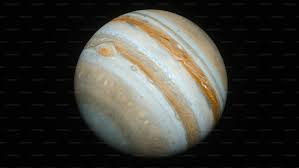
Read the facts about Jupiter below :
1. Solar System's King: Jupiter holds the undisputed title of being the largest major planet in our solar system. It is so massive that it contains more than twice the combined material of all the other planets, moons, and asteroids combined. Its tremendous scale initially led early astronomers to view it as the dominant anchor of our night sky. This colossus presents a fascinating planetary landscape for scientists trying to figure out how its massive, fuzzy core managed to accumulate so much volatile gas during the volatile, early era of the infant Sun.
2. Colossal Atmospheric Storms: Despite lacking a solid surface, Jupiter has a thick atmosphere packed with violent weather. Churned by the planet's internal heat, the atmosphere features colorful bands of frozen ammonia clouds racing parallel to the equator. The most dangerous of these storms is the Great Red Spot, a giant high-pressure vortex wider than Earth that has been observed for over two centuries. This extreme atmospheric activity drives continuous lightning strikes and massive cloud dynamics across the globe.
3. Extreme Rotational Dynamics: The rotational dynamics of Jupiter are uniquely complex, turning the concept of time upside down. The planet has the shortest day in the solar system, completing a full rotation on its axis in a blistering 9.9 hours. Because of this rapid spin, the gas giant actually flattens at its poles and bulges out along its equator. This rapid rotation fuels a perpetual hurricane network, resulting in highly prolonged jet streams that wrap violently around the entire planet.
4. Flattened Orbital Presentation: If you could somehow survive to look out from the upper clouds of Jupiter, you would witness a highly unusual sky. Because Jupiter's axial tilt is a mere 3 degrees, the planet spins nearly perfectly upright relative to its orbital path. As the planet moves through its twelve-year journey around the Sun, it experiences virtually no extreme seasonal changes. This stable solar angle means the polar regions remain locked in a perpetual, cold alignment, anchoring long-term vortex arrangements.
5. Miniature Solar System Status: Unlike Earth with its single, tide-controlling Moon, Jupiter boasts a complex network of dozens of natural satellites that resemble a miniature solar system. It possesses over a hundred moons alongside a faint, four-part system of planetary rings made of dust. Astronomers believe that its immense gravitational pull allowed it to easily capture passing space debris and hold long-term orbits. The four largest satellites—Io, Europa, Ganymede, and Callisto—were first recorded by Galileo in 1610.
6. Deep and Heavy Atmosphere: Flying into the outer layers of Jupiter would feel like entering an endless expanse of shifting gas. The planet possesses the largest planetary atmosphere in the solar system, composed of roughly 90% hydrogen and 10% helium. Lacking a distinct solid crust, the atmospheric boundary layer simply grows denser and hotter under crushing pressure, seamlessly morphing into a global liquid ocean. This immense blanket traps residual energy left over from the planet’s formation.
7. Jovian Cloud-Banded Landscape: The striking, colorful bands that define Jupiter are heavily sculpted by continuous atmospheric convection. Because it has intense internal heat rising from its core, Jupiter creates parallel belts of light, ascending gases and dark, descending flows. The most famous of these structures is the Great Red Spot, a colossal storm extending roughly 500 kilometers deep into the planet. This magnificent vortex system has remained dynamically stable without a solid terrain to slow it down.
8. The Cosmic Bodyguard: Because it sits as the heaviest object orbiting our star, Jupiter moves with incredible gravitational intensity. It travels along its orbital path while altering the trajectories of surrounding asteroids and comets. Throughout history, its strong gravity has acted as a shield for Earth, deflecting dangerous space debris out of the inner solar system. Without this massive gravitational interceptor, Earth would likely face far more frequent and life-threatening cosmic impacts.
9. Distant Solar Proximity: Sitting as the fifth planet out from the center of our solar system, Jupiter rests at an average distance of roughly 778 million kilometers from the Sun. At this baseline distance, a beam of solar radiation takes about 43 minutes to traverse the void of space and reach its clouds. This far-off placement keeps the cloud tops at a freezing average temperature of -110°C. Instead of relying on sunlight, the planet's violent weather is powered internally by its own contracting core.
10. Mythological Identity: Because of its brilliant, slow-moving appearance in the night sky, ancient cultures across the globe associated the planet with supreme power. The ancient Romans named the planet after Jupiter, their chief deity of the sky, thunder, and political order. Fittingly, because it reigns as the largest world, modern astronomers have continued this legacy by naming its surrounding moons and features after characters associated with the mythological king.
11. Subsurface Water Oceans: Jupiter serves as an exciting center for real-world research regarding alien life surviving on frozen moons. Because the moon Europa is enveloped in a thick shell of solid water ice, its interior remains hidden from view. However, gravitational mapping data shows that tidal flexing keeps the moon's interior warm. Underneath its global icy crust sits a massive liquid water ocean that may possess all the necessary biological ingredients to sustain primitive organisms.
12. Liquid Metallic Interior: The interior of Jupiter features a highly unique physical phenomenon dominated by extreme pressure. Scientists have determined that thousands of kilometers beneath the cloud tops, hydrogen gas is squeezed so tightly that its atoms break apart. This global compression transforms the gas into a swirling sea of liquid metallic hydrogen that conducts electricity perfectly. This metallic ocean acts as a massive generator, driving the planet's immense magnetic field.
13. Hydrogen Star Chemistry: Jupiter is categorized as a gas giant, occupying a distinct class alongside Saturn, Uranus, and Neptune. Beneath its outermost clouds, it shares almost the exact chemical recipe as a developing star. If the planet had grown roughly 80 times more massive during its formation, the internal pressure would have ignited nuclear fusion. Because it fell short of this threshold, it remains a planet, often referred to by astronomers as a "failed star".
14. Solar Wind Interactions: While the planet lacks a rocky terrain, its outermost magnetosphere interacts dynamically with the sun. This phenomenon is driven by the intense solar wind colliding with Jupiter’s powerful magnetic shield. The high-energy particles are channeled directly toward the poles, igniting permanent auroral displays. These brilliant auroras are continually supercharged by sulfur and oxygen atoms expelled from the nearby volcanic moon Io.
15. Tiny Solar Geometry: Most inner planets view the Sun as a large, bright circle in the daytime sky. However, because Jupiter spins at a great distance from the center of the solar system, it experiences a highly reduced view. From the upper clouds of Jupiter, the Sun appears only a fifth of the width it does from Earth. This distant geometry cuts down the incoming solar light significantly, leaving the outer atmosphere dependent on internal heat transport.
16. Massive Global Magnetic Field: Unlike Venus or Mars, which lack a strong internal magnetic defense, Jupiter possesses the largest magnetic field of any planet. It is up to 54 times stronger than Earth's, creating a massive magnetosphere that stretches millions of kilometers into space. This active field indicates that its interior layer of liquid metallic hydrogen is constantly churning. The resulting dynamo generates an intense radiation belt that can easily fry unprotected electronic spacecraft.
17. Extended Orbital Path: While a single day on Jupiter flies by in less than ten hours, its journey around the Sun is exceptionally long. The planet travels along its massive outer path at a measured pace, taking 11.86 Earth years to complete a single Jovian year. Because its orbit takes over a decade, navigating a spacecraft to Jupiter requires meticulous calculations to align with the planet's position across its wide orbital arc.
18. Ancient Planetary Ancestry: Out of all the worlds in our solar system, Jupiter holds the title of being the oldest planet. Planetary models show that it formed first, absorbing the bulk of the gas and dust left over after the birth of the Sun. Tracking its deep composition allows scientists to peak back into the primitive solar system's chemistry. Because it has locked away these ancient elements for billions of years, it acts as a perfect time capsule.
19. Fluid Unchanging History: When scientists examine the structure of Jupiter using advanced microwave radiometers, they notice a lack of traditional geology. The entire planet lacks plate tectonics, volcano craters, or solid canyons due to its completely fluid architecture. Instead, the planet's atmospheric features, like its polar vortex crystals, maintain their geometric patterns for years. The cloud layers preserve a continuous record of fluid dynamics undisturbed by solid land masses.
20. Robotic Exploration Legacy: Jupiter holds a highly prominent position in the timeline of human space exploration. Because it is surrounded by intense radiation belts, entering its orbit safely is incredibly dangerous for spacecraft. It was first visited by NASA's Pioneer 10 flyby in 1973, followed by the historic Voyager missions. Decades later, NASA's Galileo and Juno missions achieved the monumental feat of orbiting the planet, braving the radiation to drop atmospheric probes and reveal the gas giant's deep interior secrets.