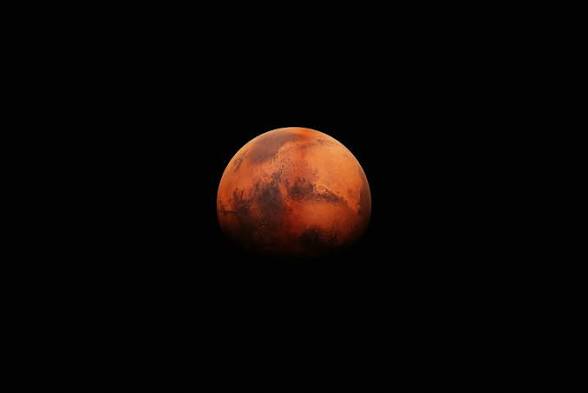
Read the facts about Mars below :
1. Solar System's Runner-Up: Mars holds the title of being the second-smallest planet in our solar system, right after Mercury. It is roughly half the diameter of Earth, meaning it has a much lower surface gravity—only about 38% of Earth's. This smaller size initially made scientists wonder how well it could retain an atmosphere over billions of years. This compact desert world presents a fascinating planetary archive for scientists trying to figure out how a planet that started so similar to Earth ended up losing its global habitability.
2. Freezing Temperature Swings: Despite its thin atmosphere, Mars struggles to trap thermal energy effectively due to its distance from the Sun. Without a thick blanket of greenhouse gases, the planet experiences incredibly cold temperatures across its surface. During a rare summer day at the equator, conditions can reach a comfortable 20°C. However, during the planetary nights and winters at the poles, temperatures instantly plummet to a freezing -153°C. This extreme cold causes carbon dioxide gas to freeze directly into solid dry ice on the polar caps.
3. Earth-Like Rotational Dynamics: The rotational dynamics of Mars are strikingly familiar, mirroring the daily cycles found on Earth. A Martian day, known to scientists as a "sol," lasts exactly 24 hours, 39 minutes, and 35 seconds. Furthermore, Mars spins on an axial tilt of approximately 25 degrees, which is nearly identical to Earth's 23.5-degree tilt. This shared orientation means Mars experiences four distinct seasons, although each season lasts twice as long because the Martian year is significantly extended.
4. Elliptical Orbital Path: If you were to stand on the surface of Mars, you would notice its orbital path creates unique climate variations. Because Mars' path around the Sun is highly elliptical, its distance from the Sun varies wildly throughout its long year. At its closest point (perihelion), the intense solar heating triggers massive global dust storms that can shroud the entire world for weeks. This variable orbital speed means that southern hemisphere seasons are far more extreme than those in the north.
5. Companion Moon Duo: Unlike Earth with its single massive Moon, Mars is orbited by a duo of tiny, captured natural satellites. Named Phobos and Deimos after the mythological horses of the Roman war god, these moons are heavily cratered, potato-shaped objects that resemble stray asteroids. Phobos orbits so closely to Mars that it is slowly spiraling inward, destined to either crash into the planet or break apart into a beautiful planetary ring system millions of years from now.
6. Fragile Carbon Dioxide Atmosphere: Walking on the surface of Mars without a spacesuit would result in immediate asphyxiation. The planet possesses a thin, fragile atmosphere that is 100 times less dense than Earth's, consisting of 95% carbon dioxide, 2.6% nitrogen, and 1.9% argon. Lacking a thick ozone shield or dense atmospheric buffer, the Martian surface is bombarded by harsh ultraviolet solar radiation and cosmic rays, making it a highly hostile environment for unshielded organic life.
7. Rust-Colored Red Landscape: The striking, rusty-red appearance that defines Mars is caused by a heavy concentration of iron oxide covering its surface dust and rocks. Because the planet lacks liquid surface water to wash it away, this fine dust is carried by winds across the globe, coloring both the landscape and the sky a pinkish-orange. Beneath this rusty topsoil lies an ancient basaltic crust scarred by billions of years of volcanic activity, impact craters, and dried-up waterways.
8. Volcanic Giants: Because Mars lacks active plate tectonics, its volcanic hot spots remained stationary for billions of years, allowing magma to pile up continuously in single locations. This geological stability created Olympus Mons, a shield volcano that stands as the largest mountain in the solar system. Rising 21 kilometers into the thin Martian sky, Olympus Mons is three times higher than Mount Everest and is so wide that its base would completely cover the country of France.
9. Sun Proximity and Distance: Sitting as the fourth planet out from the center of our solar system, Mars rests at an average distance of roughly 228 million kilometers away from the Sun. At this baseline distance, a beam of solar radiation takes about 12.6 minutes to traverse the void of space and reach the Martian surface. This distance results in Mars receiving less than half the solar energy that Earth enjoys, keeping the planet locked in a perpetual, cold desert state.
10. Mythological Identity: Because of its bright, blood-red appearance in the night sky, ancient cultures across the globe associated the planet with warfare and conflict. The ancient Romans named the planet after Mars, their prominent god of war and agricultural guardian. Fittingly, because of this martial legacy, modern astronomers have named its giant surface features, mountains, and craters after famous scientists, writers, and terrestrial locations that advanced human understanding of geography and exploration.
11. Subterranean and Polar Ice: Mars serves as a fascinating real-world treasure trove of ice hiding just beneath its dry exterior. While liquid water cannot exist for long on its surface due to the low atmospheric pressure, vast quantities of water ice are preserved at the poles. Radar mapping missions have also revealed massive glaciers and ice sheets buried beneath layers of protective dust across the mid-latitudes, acting as a crucial reservoir for future human explorers.
12. Giant Fractured Canyonlands: The surface of Mars features a highly unique geological scar known as Valles Marineris. This massive canyon system stretches for over 4,000 kilometers along the Martian equator, plunging up to 7 kilometers deep in some areas. Geologists have determined that this canyon did not form via water erosion like Earth's Grand Canyon; instead, it is a giant tectonic crack that split the crust open as the nearby volcanic Tharsis region bulged upward.
13. Core and Crust Architecture: Mars is categorized as a terrestrial or rocky planet, sharing a physical class with Mercury, Venus, and Earth. Beneath its solid outer crust sits a mantle composed mostly of silicates and an internal core made of iron, nickel, and sulfur. Unlike Earth's liquid outer core, Mars' interior has mostly cooled and quieted down over time. This architectural layout leaves the planet without a dynamic internal engine to generate a powerful global magnetic field.
14. Global Dust Storm Interactions: While the planet lacks rain or snow, its thin atmosphere interacts dynamically with surface dust. Powered by solar heating, fierce winds sweep across the plains, generating massive dust devils and localized storms. During seasonal transitions, these separate storms can merge into a single, planet-wide dust shroud. This global phenomenon blocks out daylight for months at a time, presenting a major power hazard for solar-powered robotic landers.
15. Diminished Solar Geometry: Most planets in the inner solar system view the Sun as a large, blinding orb. However, because Mars orbits at a much greater distance, it experiences a noticeably diminished view of our home star. If you were standing on its surface, the Sun would appear only about half the size it does from Earth. This distance dominates the daytime environment, casting a dim, cold light across the stark landscape and turning sunrises and sunsets a beautiful, unnatural blue.
16. Vanished Global Magnetic Field: Unlike Earth, which uses its liquid core to shield itself from solar radiation, Mars possesses no active global magnetic field today. It lost this vital defensive shield around 4 billion years ago when its core cooled. Because it lacked a magnetic dynamo, high-energy solar winds were able to strip away the vast majority of its ancient, thick atmosphere over time, transforming a once warm and wet world into a frozen wasteland.
17. Extended Orbital Journey: While a single day on Mars matches Earth almost perfectly, its journey around the Sun takes far longer. The planet travels along its elliptical path at a slower pace, taking roughly 687 Earth days—nearly two Earth years—to complete a single Martian year. Because its orbit is long, seasonal changes stretch out over many months, forcing robotic missions to survive long, grueling winters before returning to peak operational capacity.
18. Ancient Waterways and Ocean Beds: When scientists examine the surface of Mars using advanced imaging, they find clear evidence of an ancient, water-rich past. The landscape is crisscrossed by winding river valleys, massive outflow channels, and delta formations where rivers once emptied into ancient lakebeds. This physical evidence proves that billions of years ago, Mars possessed a much thicker atmosphere and a fully functional water cycle capable of supporting liquid seas.
19. Stable Planetary History: Because Mars lacks active plate tectonics to destroy old crust, its surface features have remained remarkably stable for billions of years. Impact craters from the solar system's earliest days sit perfectly preserved alongside ancient volcanoes and dried-up riverbeds. Because it lacks wind and water erosion on a massive scale, the planet acts as a pristine time capsule, allowing geologists to study features that were erased on Earth long ago.
20. Robotic Exploration Armada: Mars holds the most celebrated position in the timeline of human planetary exploration. Because its environment is accessible, it has hosted a continuous fleet of robotic spacecraft since the late 20th century. From early flybys like Mariner 4 to legendary rovers like Curiosity and Perseverance, humanity has mapped its valleys, analyzed its soil, and searched its rocks for signs of ancient microbial life, paving the way for future human footsteps.