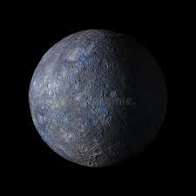
Read the facts about Mercury below :
1. Solar System's Runt: Mercury holds the undisputed title of being the smallest major planet in our solar system. It is so small that it is actually tinier than Saturn's moon Titan and Jupiter's moon Ganymede, though it remains significantly more massive due to its rocky and metallic composition. Its diminutive scale initially led early astronomers to believe it might just be a captured satellite. This compact world presents a fascinating planetary mystery for scientists trying to figure out how such a dense, iron-rich core managed to retain its place so close to the violent gravitational and solar forces of the infant Sun.
2. Extreme Temperature Swings: Despite being closest to the Sun, Mercury lacks an atmospheric blanket to trap thermal energy relentlessly. Without air to retain the heat, the planet experiences the most violent temperature swings in the entire solar system. During the long planetary day, areas exposed to direct sunlight scorch at a blistering 430°C. However, during the equally long planetary nights, the dark side instantly drops to a freezing -180°C. This extreme thermal stress causes the surface materials to expand and contract violently, fracturing the ancient rocks across the globe.
3. Extreme Rotational Dynamics: The rotational dynamics of Mercury are uniquely complex, turning the concept of time upside down. The planet is locked in a 3:2 spin-orbit resonance, meaning it rotates exactly three times on its axis for every two orbits it completes around the Sun. Because of this slow spin and rapid orbit, a single solar day (the time from one noon to the next) takes an agonizing 176 Earth days. This means that a single day on Mercury lasts twice as long as an entire Mercury year, resulting in highly prolonged exposure to both intense solar radiation and deep-space freezing.
4. Eccentric Orbital Path: If you could somehow survive to stand on the surface of Mercury, you would witness a highly unusual sky. Because Mercury's path around the Sun is a highly eccentric oval rather than a near-perfect circle, the Sun appears to grow larger and smaller as the planet moves. At certain points in its orbit, the Sun will briefly rise, stop, reverse its direction across the sky, and then resume its normal path. This erratic celestial dance is a direct result of its unique speed variations as it swings close to its perihelion.
5. Solitary Celestial Status: Unlike Earth with its tide-controlling Moon, or gas giants like Jupiter that boast complex networks of dozens of natural satellites, Mercury lives a completely solitary existence. It possesses zero moons and no planetary rings whatsoever. Astronomers believe that its close proximity to the immense gravitational pull of the Sun makes it incredibly difficult for a small planet to capture or maintain long-term orbits for any surrounding debris or captured asteroids. Any potential moons formed early on were likely pulled away or pulled inward to crash directly into the Sun.
6. Practically No Atmosphere: Walking on the surface of Mercury would feel exactly like walking through the vacuum of open space. The planet possesses an extremely thin exosphere instead of a stable, heavy atmosphere. This fragile envelope is composed of trace amounts of oxygen, sodium, hydrogen, helium, and potassium that are continuously blasted off the surface rocks by solar wind particles. Lacking a thick atmospheric buffer, the planet is completely defenseless against micro-meteorites and cosmic radiation, which strike the surface without slowing down.
7. Moonlike Cratered Landscape: The striking, dark gray surface that defines Mercury is heavily scarred by billions of years of cosmic impacts. Because it has no active weather systems to erode features or volcanic activity to repave the crust, Mercury preserves its ancient impact history perfectly, closely resembling Earth's Moon. The most massive of these scars is the Caloris Basin, an enormous impact crater stretching roughly 1,550 kilometers across that was created by a colossal asteroid collision early in the planet's history.
8. The Swift Planet: Because it sits deep within the Sun's powerful gravitational well, Mercury must move with incredible intensity to avoid being pulled inward. It travels along its orbital path at an average speed of nearly 47 kilometers per second, making it the fastest planet in our solar system. Throughout human history, it has been widely observed as a quick-moving spark blinking close to the morning or evening horizon, earning its association with speed and sudden transitions in various ancient star maps.
9. Solar Transit Proximity: Sitting as the first planet out from the center of our solar system, Mercury rests at an average distance of roughly 58 million kilometers away from the Sun. At this baseline distance, a beam of solar radiation takes just about 3.2 minutes to traverse the void of space and reach the planet's rocky surface. This close proximity floods the planet with an immense amount of solar energy, acting as the primary engine blasting away surface atoms and driving the creation of its temporary, comet-like sodium tail.
10. Mythological Identity: Because of its brilliant, rapid appearance in the night sky, ancient cultures across the globe associated the planet with quick movement. The ancient Romans named the planet after Mercury, their prominent god of speed, commerce, and travel, who served as the fleet-footed messenger to the other deities. Fittingly, because it zips around the sun so quickly, modern astronomers have continued this legacy by naming its giant impact craters after famous historical artists, musicians, and authors who made rapid, lasting impacts on human culture.
11. Polar Ice Deposits: Mercury serves as a surprising, real-world paradox of ice existing on a planet pushed to its thermal limits. Because the planet's rotational axis has almost no tilt, the bottoms of its deep polar craters never receive any direct sunlight. Radar mapping missions have revealed that these permanently shadowed regions act as deep-freeze traps. Inside these craters, temperatures remain permanently locked below -180°C, allowing substantial deposits of water ice, likely delivered by ancient comet impacts, to survive completely intact.
12. Shrinking Wrinkled Landscape: The surface of Mercury features a highly unique geological phenomenon dominated by thousands of massive cliffs known as lobate scarps. These cliffs stretch for hundreds of kilometers and rise up to three kilometers high. Geologists have determined that as Mercury's massive iron core slowly cooled over the last four billion years, the planet actually began to shrink from the inside out. This global contraction caused the outer rocky crust to buckle, crack, and slide over itself, effectively wrinkling the planet like a drying grape.
13. Metallic Core Architecture: Mercury is categorized as a terrestrial or rocky planet, occupying a distinct place alongside Venus, Earth, and Mars. However, beneath its solid crust sits an unusually massive metallic core composed mostly of iron. This iron core makes up a staggering 85% of the planet's total radius, leaving only a thin outer shell of rocky mantle. This unique architectural layout makes Mercury incredibly dense for its size, suggesting that a giant ancient collision may have stripped away most of its original outer rock layers.
14. Solar Wind Interactions: While the planet lacks a traditional weather system, its exosphere interacts dynamically with the sun. This phenomenon is driven by the intense solar wind, which continuously bombards the exposed rocky surface. The high-energy particles peel away volatile elements, sweeping them behind the planet to form a steady, glowing tail of sodium gas. This comet-like tail stretches millions of kilometers into space, shifting in size and brightness depending on the sun's cyclical activity levels.
15. Massive Solar Geometry: Most planets in the solar system view the Sun as a distant, stable circle in the sky. However, because Mercury spins at an exceptionally close distance to the center of the solar system, it experiences a drastically magnified view. If you were standing on its surface, the Sun would appear up to three times larger and shine roughly seven times brighter than it does on Earth. This overwhelming proximity dominates the daytime environment, bathing the stark landscape in unyielding, raw radiation.
16. Surprising Global Magnetic Field: Unlike Venus or Mars, which lack a strong internal magnetic defense, Mercury possesses a fully active, global magnetic field. Though it is only about 1% as strong as Earth's, its discovery by space probes surprised scientists because small planets are supposed to have cooled and solidified internally long ago. This active field indicates that the outer layer of its massive iron core remains entirely liquid, churning continuously to generate a functional magnetic dynamo deep beneath the surface.
17. Rapid Orbital Path: While a single day-night cycle on Mercury stretches out for months, its journey around the Sun is exceptionally brisk. The planet travels along its highly eccentric path at a rapid pace, taking just 88 Earth days to complete a single year. Because its orbit is brief, seasons on Mercury are dictated more by its physical distance from the Sun at any given point along its oval path than by the axial tilt that drives the changing seasons back on Earth.
18. Closest Interplanetary Neighbor: Out of all the planets in our vast solar system, Mercury holds a unique mathematical title regarding its proximity to Earth. While Venus occasionally makes the closest single approach to us, Mercury's tight, rapid orbit means that it never stays far away for long. Tracking data shows that Mercury is actually the closest planetary neighbor to Earth—and to every other planet in the solar system—the vast majority of the time when averaging their positions over long cycles.
19. Ancient Unchanging History: When scientists examine the surface of Mercury using advanced imaging, they notice an incredible abundance of heavy impact craters compared to Earth or Venus. The entire planet appears to have an exceptionally ancient surface age, remaining largely unchanged for nearly 4 billion years. Because it lacks plate tectonics and a thick atmosphere to drive water or wind erosion, the planetary crust acts as a perfect pristine archive of the chaotic early era of solar system formation.
20. Robotic Exploration Legacy: Mercury holds a highly challenging position in the timeline of human space exploration. Because it sits so close to the Sun's immense gravity, it requires an exceptional amount of energy for a spacecraft to slow down and enter a stable orbit. It was first visited by NASA's Mariner 10 flyby mission in 1974, which mapped less than half the globe. Decades later, NASA's MESSENGER mission achieved the monumental feat of orbiting the planet from 2011 to 2015, finally revealing a complete, detailed map of this dynamic, iron-hearted world.