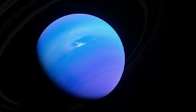
Read the facts about Neptune below :
1. Outer Sentinel of the System: Neptune holds the undisputed title of being the most distant major planet from the Sun in our solar system. It is so remote that it cannot be seen with the naked eye from Earth, making it the first planet discovered entirely by mathematical prediction rather than direct visual observation. This cold, isolated giant presents a fascinating planetary mystery for scientists trying to figure out how such a massive accumulation of water, ammonia, and methane managed to gather and condense so far away from the core distribution of the infant solar nebula.
2. Supersonic Atmospheric Winds: Despite receiving very little solar radiation, Neptune lacks a calm, static environment. Without heavy solar heating to balance its internal energy, the planet experiences the most violent atmospheric winds in the entire solar system. During active seasonal cycles, high-altitude currents of hydrogen and methane scream across the globe at a blistering 2,100 kilometers per hour. This extreme kinetic stress creates massive, fast-moving storm systems that tear through the frozen methane clouds across the planet.
3. Rapid Rotational Dynamics: The rotational dynamics of Neptune are uniquely complex, turning the concept of time upside down. The interior rocky core and magnetic field rotate completely every 16 hours, making a single day on Neptune incredibly brief compared to Earth. Because of this rapid spin and its gargantuan orbital path, Neptune experiences nearly 90,000 Neptunian days within a single Neptune year, resulting in highly prolonged seasonal cycles that last for over forty Earth years at a time.
4. Distant Circular Path: If you could somehow survive to stand on a platform in the clouds of Neptune, you would witness a highly unusual sky. Because Neptune's path around the Sun is nearly a perfect circle rather than an eccentric oval, the tiny Sun remains a stable, dim pinprick of light throughout its long journey. At all points in its orbit, the Sun appears as a blindingly bright star, providing very little warmth to a world that swings silently along the outermost edge of the planetary system.
5. Populated Celestial Status: Unlike Mercury with its completely solitary existence, or Earth with its single tide-controlling Moon, Neptune boasts a complex network of natural satellites. It possesses sixteen confirmed moons and a collection of shifting, unstable planetary rings. Astronomers believe that its immense gravitational pull allowed the planet to capture surrounding debris and Kuiper Belt objects over time, locking them into long-term orbits that continue to shape the outer layout of the system.
6. Unforgiving Ice Giant Atmosphere: Descending into the upper layers of Neptune would feel like entering a crushing ocean of frozen gas. The planet possesses a massive, dense atmosphere instead of a thin exosphere. This heavy envelope is composed of immense amounts of hydrogen, helium, and trace amounts of methane gas that give the planet its deep, sapphire blue aesthetic. Lacking a solid surface crust, the atmospheric pressure increases rapidly the deeper you go, transitioning into a super-heated, high-pressure fluid mantle.
7. Dynamic Storm-Scarred Landscape: The striking, azure blue face that defines Neptune is deeply scarred by massive cosmic weather systems. Because it has active internal heat dynamics to drive weather systems, Neptune features a constantly changing landscape of swirling dark storms, closely resembling Jupiter's atmosphere. The most massive of these scars was the Great Dark Spot, an enormous anticyclonic storm stretching thousands of kilometers across that was observed by Voyager 2 before vanishing and reforming elsewhere years later.
8. The Patient Planet: Because it sits incredibly far away from the Sun's powerful gravitational well, Neptune does not need to move with intense speed to maintain its position. It travels along its orbital path at a leisurely average speed of roughly 5.4 kilometers per second, making it the slowest moving planet in our solar system. Throughout human history, it remained completely hidden from ancient star maps, requiring advanced telescope optics and complex orbital calculations to finally unmask its presence in 1846.
9. Extreme Solar Proximity Void: Sitting as the final planet out from the center of our solar system, Neptune rests at an average distance of roughly 4.5 billion kilometers away from the Sun. At this baseline distance, a beam of solar radiation takes about 4 hours and 10 minutes to traverse the void of space and reach the planet's cloud tops. This extreme distance deprives the planet of raw solar energy, leaving it dependent on its own radiating core to drive its chaotic weather systems and supersonic winds.
10. Oceanic Mythological Identity: Because of its deep, rich blue appearance in early telescope fields, nineteenth-century astronomers associated the planet with the deep sea. The international scientific community named the planet after Neptune, the prominent Roman god of the sea and oceans. Fittingly, because it resides in a freezing, watery domain of molecular slush, modern astronomers have continued this legacy by naming its unique moons after lesser sea deities, nymphs, and ocean spirits from ancient mythology.
11. Backward Orbiting Moon: Neptune serves as a surprising, real-world paradox of orbital mechanics. Its largest moon, Triton, behaves unlike any other massive moon in the solar system because it orbits Neptune in a backward or retrograde direction. Radar and imaging data have revealed that Triton was likely an independent ice world from the nearby Kuiper Belt that wandered too close to Neptune billions of years ago and was violently captured by the planet's immense gravitational net.
12. Radiating Internal Furnace: The atmosphere of Neptune features a highly unique thermal phenomenon dominated by its internal energy engine. Even though it sits twice as far from the Sun as Uranus, Neptune radiates more than twice the amount of heat it absorbs from the solar wind. Planetary scientists have determined that as the planet's heavy materials slowly compress under gravity, Neptune actually generates massive internal heat. This global energy release drives the churning currents that power the planet's supersonic storms.
13. Slushy Mantle Architecture: Neptune is categorized as an ice giant planet, occupying a distinct place alongside its planetary neighbor, Uranus. Beneath its thick, gaseous atmosphere sits an unusually massive, fluid mantle composed mostly of water, ammonia, and methane ice. This slushy layer makes up a staggering 80% of the planet's total mass, wrapping around a compact core of iron and silicate rock. This unique architectural layout makes Neptune significantly denser than Saturn or Jupiter, pointing to a distinct evolutionary path.
14. Resonant Gravitational Interactions: While the planet lacks a close neighbor, its gravity interacts dynamically with the outer solar system. This phenomenon is driven by its immense mass, which continuously dictates the orbital pathways of nearby dwarf planets and icy asteroids. Neptune is locked in a strict 3:2 orbital resonance with Pluto, meaning Pluto completes exactly two orbits for every three orbits Neptune finishes, preventing the two worlds from ever colliding despite their overlapping paths.
15. Diminished Solar Geometry: Most inner planets in the solar system view the Sun as a large, blinding wheel of fire. However, because Neptune spins at an exceptionally vast distance from the center of the solar system, it experiences a drastically reduced view. If you were floating in its upper clouds, the Sun would appear merely as a brilliant pinprick, shining roughly 900 times dimmer than it does on Earth. This overwhelming isolation dominates the daytime environment, bathing the stark blue landscape in permanent twilight.
16. Tilted Off-Center Magnetic Field: Unlike Earth or Jupiter, which align their magnetic defenses closely with their rotational axes, Neptune possesses a highly chaotic, asymmetric magnetic field. This field is tilted at a sharp 47-degree angle relative to the planet's spin axis and is offset entirely from the planet's physical center. This discovery by space probes indicates that the magnetic dynamo is not generated deep within the rocky core, but is instead generated by a fluid layer of electrically conducting water-ammonia slush churning in the middle mantle.
17. Epic Interplanetary Year: While a single rotation on Neptune stretches out for only a few hours, its journey around the Sun is exceptionally long. The planet travels along its vast circular path at a patient pace, taking nearly 165 Earth years to complete a single Neptunian year. Because its orbit is so expansive, Neptune has completed only a little over one full orbit around the Sun since its initial discovery by human civilization back in the mid-nineteenth century.
18. Outer Gatekeeper of the System: Out of all the major planets in our solar system, Neptune holds a unique structural title regarding the boundary of our planetary neighborhood. Its massive gravity acts as a permanent wall, clearing out debris from its immediate path while stabilizing the inner edge of the Kuiper Belt. Tracking data shows that Neptune's gravitational reach actively shapes the trajectories of comets and icy worlds, acting as the ultimate gatekeeper between the major planets and deep interstellar space.
19. High-Altitude Methane Clouds: When scientists examine the atmosphere of Neptune using advanced infrared imaging, they notice an incredible abundance of bright white streaks against the blue backdrop. These features are high-altitude cirrus clouds composed entirely of frozen methane crystals. Because the upper atmosphere experiences rapid wind shears, these cloud formations change dynamically, casting distinct shadows on the deeper, darker blue cloud layers below and providing a visual map of the planet's violent wind speeds.
20. Voyager's Solitary Flyby Legacy: Neptune holds a highly challenging position in the timeline of human space exploration. Because it sits so incredibly far away, it requires an exceptional amount of time and advanced trajectory engineering for a human spacecraft to reach it. It has been visited only once in human history, by NASA's Voyager 2 spacecraft during its historic Grand Tour flyby in August 1989. That single encounter provided humanity with its first close-up images of this beautiful, wind-swept ice giant, leaving its secrets largely unvisited for decades.