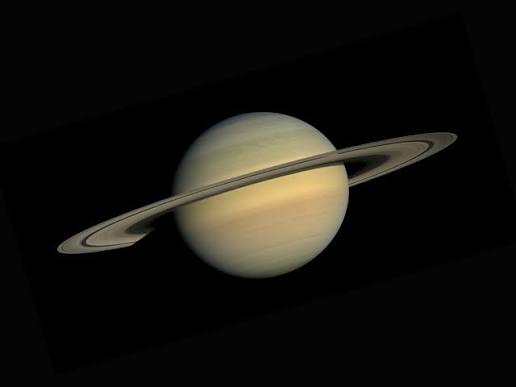
Read the facts about Saturn below :
1. Solar System's Ringed Giant: Saturn holds the undisputed title of being the second-largest planet in our solar system. It is so massive that Earth could fit inside it an incredible 764 times. Despite its grand scale, it has the lowest density of any planet because it is composed mainly of lighter gases. This compact yet expansive structure presents a fascinating planetary mystery for scientists trying to figure out how its heavy internal pressure and core mechanics interact deep beneath the swirling, yellow cloud decks.
2. Freezing Cloudtop Dynamics: Far from the warmth of the Sun, Saturn lacks a close-range solar engine to heat its outer layers. Without intense external heat, the cloud tops experience freezing temperatures averaging around -140°C to -180°C. However, deep inside the planet, the core generates extreme internal warmth, rising to temperatures near 11,700°C. This massive temperature variance between the freezing exterior and burning interior creates powerful convective currents that drive relentless, planet-wide storms.
3. Intense Rotational Speed: The rotational dynamics of Saturn are uniquely complex, turning the planet into an oblate spheroid. The planet spins at an incredible rate, completing a full turn on its axis in roughly 10.5 hours. Because of this blistering speed, centrifugal forces cause Saturn to flatten significantly at its poles and bulge outwardly at its equator. This rapid spin also acts as the primary engine driving its ultra-fast atmospheric winds, which sweep through the upper layers.
4. Grand Ring Architecture: If you could view Saturn from a nearby spacecraft, you would witness the most spectacular sight in the solar system. Its iconic ring system spans up to 270,000 kilometers across but remains astonishingly thin, averaging only about 10 meters thick in most places. These expansive sheets are made up of billions of pieces of water ice, rocky debris, and cosmic dust. This delicate gravitational dance is continuously shaped by small shepherd moons that clear paths and maintain the crisp gaps between the ring structures.
5. King of Moons: Unlike Earth with its solitary companion, or inner worlds that have zero satellites, Saturn boasts an enormous, complex network of natural satellites. With 293 confirmed moons, it holds the title for the most satellites in the solar system. These moons range from massive worlds with their own distinct geography to tiny trailing asteroids captured by the gas giant's immense gravitational pull. This dynamic orbit system functions like a miniature solar system nested inside the outer realm.
6. No Solid Surface: Decending into the environment of Saturn would feel nothing like landing on a rocky world. The planet is a gas giant with no solid surface to touch down upon. A spacecraft trying to land would simply sink through thick layers of hydrogen and helium gas, experiencing a continuous increase in temperature and pressure. Eventually, the deep atmospheric pressure becomes so intense that gases condense into a vast ocean of liquid metallic hydrogen.
7. Jovian Atmospheric Weather: The swirling yellow and gold bands defining Saturn are shaped by active atmospheric forces. Lacking mountains or solid landscapes to slow down air currents, Saturn experiences uninterrupted wind tracks. Equatorial winds can scream across the planet at speeds up to 1,800 kilometers per hour. The planet also hosts massive electrical storms that can grow large enough to encircle the entire globe, venting energy from the interior.
8. The Majestic Floatation Paradox: Because it sits as a world dominated by light hydrogen and helium gas, Saturn features a highly unusual physical property. It has an average density of just 0.687 grams per cubic centimeter, making it less dense than water. In a purely theoretical scenario, if you could build a bathtub or ocean large enough to hold it, the massive planet would float on the surface. This unique buoyancy underscores its gaseous, non-rocky composition.
9. Distant Solar Trajectory: Sitting as the sixth planet out from the center of our solar system, Saturn rests at an average distance of roughly 1.4 billion kilometers from the Sun. At this remote distance, a beam of solar radiation takes about 80 minutes to traverse the deep void and reach the planet. This vast gap means Saturn receives a mere 1% of the sunlight intensity that reaches Earth, leaving it illuminated in a dim, cold, perpetual twilight.
10. Agricultural Mythological Identity: Because of its slow, steady movement through the night sky, ancient cultures associated the planet with time and patience. The ancient Romans named the planet after Saturn, their prominent god of agriculture, wealth, and harvest, who was also known as the father of Jupiter. Fittingly, because it moves so gracefully through its long orbit, modern astronomers have continued this legacy by naming its rings alphabetically in the order they were discovered.
11. Polar Hexagonal Storm: Saturn serves as a real-world home to one of the most bizarre and geometric weather phenomena in the universe. At its north pole, a permanent jet stream flows in a near-perfect, six-sided hexagon pattern. Each side of this massive weather structure is wider than the entire planet Earth. This geometric anomaly has puzzled scientists for decades, remaining stable and anchored at the pole while spinning winds howl within its borders.
12. Titan's Alien Landscape: Saturn's largest satellite, Titan, stands out as an exceptional world that acts more like a planet than a moon. It is larger than the planet Mercury and is the only moon in the solar system shrouded in a dense, thick atmosphere. Titan features a complete liquid cycle on its freezing surface, complete with clouds, rain, rivers, and massive lakes. However, instead of water, this hydrological system runs entirely on liquid methane and ethane.
13. Deep Core Architecture: Saturn is categorized as a gas giant, occupying a distinct place alongside its neighbor Jupiter. However, beneath its deep layers of churning gas sits a dense interior core. This core is believed to contain a slushy mix of high-pressure rock, metals, and exotic forms of ice. This massive internal engine accounts for about 60% of the planet's diameter and holds the mass of roughly 55 Earths, serving as the source for the planet's strong magnetic dynamics.
14. Powerful Internal Heat Engine: While the planet lacks a solid surface, its interior generates immense energy. This phenomenon is driven by gravity pulling heavier helium droplets downward through its liquid hydrogen layers, a process that acts like a massive planetary heat pump. This friction creates so much internal warmth that Saturn actually radiates 2.5 times more heat into space than it receives from the sun. This internal output is what keeps its atmospheric currents highly active.
15. Symmetrical Magnetic Alignment: Most planets with magnetic fields display a noticeable tilt between their physical spin axis and their magnetic poles. However, because Saturn features a highly uniform internal layout, it breaks this trend. Its global magnetic field is almost perfectly aligned with its rotational axis, with a tilt of less than one degree. This rare symmetrical layout creates clean, balanced radiation belts that smoothly envelope the planet and its inner rings.
16. Planetary Ring Rain: Unlike its ancient gas core, Saturn's magnificent rings are not permanent fixtures. Scientists analyzing data have discovered that the rings are actively draining into the planet through a process called "ring rain". Intense solar radiation and magnetic fields charge the icy ring particles, causing them to be pulled along magnetic lines into the upper atmosphere. An Olympic-sized swimming pool of water material falls from the rings every half hour, meaning they could disappear entirely in 100 million years.
17. Prolonged Orbital Seasons: While a single day on Saturn is short and fast, its journey around the Sun requires incredible patience. The planet moves along a vast orbital path, taking roughly 29.4 Earth years to complete a single Saturnian year. Because of its 26.7-degree axial tilt and lengthy orbit, seasons on Saturn last for more than seven Earth years at a time. This results in decades-long shifts in lighting across its ring planes.
18. Naked-Eye Observation History: Out of all the planets known to early human history, Saturn holds the title for being the most distant world visible without advanced optics. For thousands of years, ancient stargazers tracked its slow, golden track across the night sky. Because it marks the edge of what can be seen by the unaided human eye, it was long considered the final boundary of the solar system before the invention of the telescope unlocked its hidden rings and moons.
19. Pristine Archive Moons: When scientists examine the smaller moons of Saturn using advanced space probes, they notice incredible geologic diversity. For instance, the moon Enceladus features a global subsurface ocean that shoots massive plumes of salty water ice out into space through active geysers. These frozen eruptions feed material directly into Saturn's outer E-ring, acting as a pristine chemical archive that allows space probes to sample an alien ocean without ever having to land.
20. Space Exploration Milestones: Saturn holds a legendary position in the timeline of human deep-space exploration. Getting a spacecraft out to its distant orbit requires precise trajectory math and years of travel. It was first visited by flyby missions like Pioneer 11 and the Voyager probes, which captured our first close views. Decades later, the historic international Cassini-Huygens mission achieved the monumental feat of orbiting Saturn from 2004 to 2017, transforming our understanding of this ringed gas giant.