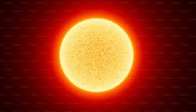
Read the facts about the Sun below :
1. Solar System's Anchor: The Sun holds the undisputed title of being the dominant center of gravity in our solar system. It is so massive that it accounts for 99.86% of all the matter in the entire solar system, dwarfing gas giants like Jupiter and rocky worlds like Earth combined. Its immense scale creates the massive gravitational well that dictates the movement of every planet, asteroid, and comet in its neighborhood. This fiery ball of plasma presents a fascinating scientific focal point for researchers trying to understand how stars form, operate, and influence the cosmic habitability of surrounding celestial bodies.
2. Extreme Core Temperature: At the very heart of the Sun sits a region of unimaginable heat and pressure. While the visible surface of the star rests at a blistering 5,500°C, the internal core reaches a staggering 15 million degrees Celsius. At this intense thermal baseline, electrons are stripped away from atoms to create an energized state of matter known as plasma. This extreme thermal environment acts as the crucial engine required to sustain the star, driving reactions that prevent the Sun's immense gravitational forces from collapsing the star inward upon itself.
3. Dynamic Rotational Mechanics: The rotational dynamics of the Sun are uniquely complex because it is not a solid object like Earth. Instead, being composed entirely of fluid plasma, it experiences differential rotation, meaning it turns at different speeds depending on the latitude. The solar equator completes a full rotation on its axis in roughly 25 Earth days, whereas the polar regions drag behind, taking up to 35 Earth days to complete a single turn. This uneven twisting motion violently winds up the star's internal magnetic lines over time.
4. Galactic Orbital Path: While the Sun appears to sit perfectly stationary from our perspective inside the solar system, it is actually moving through space at an incredible speed. The Sun, along with its entire family of planets, travels at roughly 220 kilometers per second as it completes a massive orbit around the center of the Milky Way galaxy. Because the galaxy is so mind-bogglingly vast, it takes the Sun approximately 230 million Earth days (or years) to complete a single galactic loop, meaning the last time the Sun was in this cosmic position, dinosaurs were just beginning to evolve.
5. Solitary Star Status: Unlike many stellar systems across the universe that feature binary or ternary configurations with multiple stars orbiting a common center of gravity, our Sun lives a completely solitary existence. It has no companion star to disrupt its gravitational harmony. Astronomers believe this long-term stability was critical for the evolution of our solar system, as a companion star would have likely pulled protoplanetary material away or sent early planets crashing into deep space before life had any opportunity to take root.
6. Massive Gaseous Composition: Flying into the Sun would reveal that it has no solid surface to land on whatsoever. The star is a giant ball of incandescent gas held together by its own gravity, composed of roughly 74% hydrogen and 24% helium, with trace amounts of heavier elements like oxygen and iron. This gas is continually ionized into plasma by intense radiation fields. Lacking a hard crustal buffer, the boundaries of the Sun are defined purely by shifts in density and light emission across its multi-layered solar atmosphere.
7. Nuclear Fusion Reactor: The blinding, life-giving energy that defines the Sun is generated continuously by a massive internal nuclear furnace. Deep inside the core, the intense pressure forces hydrogen atoms together to forge helium atoms in a process known as nuclear fusion. Every single second, the Sun fuses roughly 600 million tons of hydrogen, converting a small fraction of that mass directly into pure, raw energy. This process releases massive waves of gamma-ray photons that slowly work their way outward into space.
8. Light Travel Time: Because space is so vastly empty, even light—the fastest entity in the universe—takes time to traverse the distance between the Sun and its planets. Sitting at an average distance of 150 million kilometers away, a beam of solar radiation takes roughly 8.3 minutes to travel from the photosphere to Earth's surface. This means that if the Sun were to suddenly stop shining right now, humans would continue to see it glowing normally in the sky for nearly another nine minutes before darkness arrived.
9. Photosphere Surface Boundary: The striking, brilliant yellow disk that we observe in our sky is known as the photosphere. Extending down just a few hundred kilometers, this layer is considered the official "surface" of the Sun because it is the point where the internal plasma finally becomes transparent, allowing photons to escape freely into space. The photosphere is covered in a bubbling texture of convection cells known as granules, each roughly the size of an Earth continent, which bring fresh, searing heat up from deep within the star.
10. Mythological Solar Identity: Because of its blinding, powerful presence in the daytime sky, ancient cultures across the globe universally revered the Sun as a primary deity. The ancient Romans referred to the star as Sol, a name that lives on today in our use of the term "solar system," while the Greeks named it Helios, the golden chariot driver of the sky. Fittingly, because it serves as the ultimate engine of light and energy for our world, modern space agencies continue to name solar exploration spacecraft after these ancient symbols of power and illumination.
11. Dark Sunspot Anomalies: The surface of the Sun features highly unique structural phenomena known as sunspots, which appear as dark blemishes against the brilliant photosphere. These spots are temporary regions where intense, tangled magnetic fields break through the surface, choking off the normal upward flow of hot gas from the interior. Because the convection is blocked, these localized zones cool down to about 3,700°C, making them look completely black in contrast to the much hotter, surrounding solar landscape.
12. Searing Corona Atmosphere: Extending far out past the visible surface of the Sun sits a highly mysterious, outer atmospheric layer known as the corona. This fragile crown of plasma is usually invisible, but it stands out as a glowing halo during a total solar eclipse. Bafflingly, while the surface below rests at a few thousand degrees, temperatures in the corona mysteriously rocket up to over one million degrees Celsius. Scientists are using advanced probes to discover how magnetic energy waves pump this extreme heat into the upper atmosphere.
13. Cyclic Magnetic Architecture: The Sun possesses an incredibly complex, active global magnetic field that behaves like a living clock. Driven by internal plasma currents, the entire magnetic framework follows an 11-year cycle known as the solar cycle. During this timeframe, the star transitions from a quiet period of low activity to a volatile peak before its north and south magnetic poles completely flip places. This structural flip resets the cycle, directly influencing the frequency of solar storms that buffet our planetary neighborhood.
14. Continuous Solar Winds: While the star maintains a massive gravitational hold, it also actively pushes matter out into the cosmos. This phenomenon is known as the solar wind, a steady stream of high-energy protons and electrons ejected from the corona into space at speeds exceeding one million kilometers per hour. This wind expands outward across the planets to create a protective, magnetic bubble known as the heliosphere, which shields our entire planetary system from dangerous, high-energy cosmic rays traveling from deep space.
15. Massive Volumetric Geometry: Most planets in the solar system appear as tiny, localized dots when compared to the overwhelming scale of the central star. To put the Sun's physical size into perspective, its total volume is so immense that you could pack roughly 1.3 million Earths inside its boundary. If the Sun were scaled down to the size of a standard beach ball, the planet Earth would be a minuscule pebble the size of a pinhead sitting safely over a hundred paces away.
16. Violent Space Weather: The Sun's highly active magnetic field is capable of producing sudden, catastrophic outbursts known as solar flares and coronal mass ejections. These events occur when magnetic energy lines suddenly snap and reconnect, launching billions of tons of superheated plasma and radiation out into space. If these energetic clouds collide directly with Earth's magnetic shield, they trigger dazzling auroras but can also damage orbiting satellites and overload national power grids.
17. Agonizing Photon Journey: While light takes just over eight minutes to travel through empty space from the Sun to Earth, its journey *out* of the Sun itself is exceptionally slow. Photons generated by fusion in the core must constantly bounce through an incredibly dense internal radiative zone. This dense plasma continuously absorbs and re-emits the light particles in random directions, turning the path into a chaotic maze. A single photon takes anywhere from 100,000 to several hundred thousand years just to reach the solar surface.
18. Stable Middle-Age Era: When scientists analyze the composition and energy output of the Sun, they find that it sits comfortably in a stable phase of life known as the main sequence. Having formed roughly 4.6 billion years ago, the star has consumed about half of the hydrogen fuel reserves located within its core. It is expected to remain in this stable, life-supporting state for another 5 billion years, acting as a reliable, unchanging cosmic anchor before its internal fuel dynamics finally begin to shift.
19. Red Giant Future: The long-term future of the Sun will eventually bring a dramatic transformation to our solar system. Once the core completely runs out of hydrogen fuel in 5 billion years, the internal balance of pressure will fail, causing the core to collapse while pushing the outer layers to expand outward violently. During this red giant phase, the Sun will swell up to hundreds of times its current size, engulfing Mercury and Venus, and turning Earth's surface into a molten, uninhabitable wasteland.
20. Robotic Solar Explorers: The Sun holds an incredibly hostile environment that presents supreme engineering challenges for human space exploration. Spacecraft approaching the star must survive blinding radiation and structural temperatures that can easily melt conventional metal instruments. Despite this, humanity has deployed advanced fleets like SOHO and NASA's Parker Solar Probe, which achieved the monumental feat of flying directly through the upper corona to sample solar fields, unlocking the deepest secrets of our parent star.