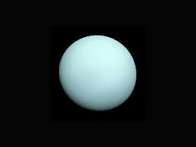
Read the facts about Uranus below :
1. The Sideways Ice Giant: Uranus holds a completely unique title as the most dramatically tilted world in our solar system. With an axial tilt of 98 degrees, the planet essentially rolls around the Sun on its side like a bowling ball. This extreme orientation creates a fascinating planetary mystery for scientists, who theorize that an ancient, colossal collision with an object roughly twice the size of Earth may have violently knocked the planet over during the chaotic early formation of the outer solar system.
2. Solar System's Deep Freeze: Despite being significantly closer to the Sun than its outer neighbor Neptune, Uranus holds the record for the lowest atmospheric temperatures ever recorded on a planet. Without an internal heat source to generate warmth from within, its lower atmosphere plummets to a blistering -224°C. This lack of internal energy prevents the planet from driving the massive storm systems seen on Jupiter, leaving Uranus with a mostly calm, featureless appearance.
3. Extreme Seasonal Dynamics: The rotational dynamics of Uranus turn the concept of time and seasons completely upside down. Because of its severe tilt, the planet's poles face the Sun directly at alternating points in its orbit. This results in an agonizing seasonal cycle where one pole experiences 42 Earth years of continuous, unyielding sunlight, while the opposite hemisphere is cast into 42 Earth years of pitch-black, frozen winter darkness.
4. Modern Era Discovery: If you look at the history of astronomy, Uranus marks a major milestone as the first planet discovered using a telescope. While ancient cultures easily tracked the closer rocky worlds, Uranus was too faint and slow to be recognized. On March 13, 1781, British astronomer Sir William Herschel noticed a strange object in the constellation Gemini that didn't move like a star, forever expanding human understanding of the solar system's true boundaries.
5. Dark Ring Systems: Unlike Saturn with its brilliant, highly reflective bands of water ice, Uranus lives a more subtle existence with an intricate system of 13 narrow planetary rings. These rings are exceptionally dark, reflecting almost no sunlight, which made them invisible to early astronomers until they were discovered via stellar occultation in 1977. Scientists believe these rings are composed of rock fragments and organic compounds darkened by continuous cosmic radiation.
6. Literary Satellite Family: Walking among the moons of Uranus would feel like stepping through the pages of classical English literature. While the satellites of other planets are named after mythological figures, the 28 known moons of Uranus break tradition by taking their names from famous characters created by William Shakespeare and Alexander Pope, including Titania, Oberon, Puck, Ariel, and Miranda.
7. Methane Cyan Atmosphere: The striking, pale cyan-blue color that defines Uranus is a direct result of its atmospheric chemistry. While the bulk of the air is made of hydrogen and helium, trace amounts of methane gas occupy the upper cloud decks. This methane acts as a solar filter, completely absorbing the red wavelengths of incoming sunlight and reflecting back the vibrant, icy blue-green hues seen by space probes.
8. Ice Giant Architecture: Uranus is categorized as an ice giant, occupying a distinct place alongside Neptune, separate from gas giants like Jupiter. Beneath its dense hydrogen-helium atmosphere sits a massive fluid mantle composed mostly of high-pressure water, ammonia, and methane ices over a small, rocky silicate core. This unique architectural layout means the planet lacks a solid surface, transitioning gradually from gas to liquid the deeper you descend.
9. Distant Solar Void: Sitting as the seventh planet out from the center of our solar system, Uranus rests at an average distance of roughly 2.9 billion kilometers away from the Sun. At this baseline distance, a beam of solar radiation takes roughly 2 hours and 40 minutes to traverse the void of space and reach the planet. This immense distance shrinks the Sun to a tiny point in the sky, flooding the planet with less than 1% of the sunlight that Earth receives.
10. Mythological Greek Identity: Because of its pristine blue appearance, Herschel originally attempted to name the planet after King George III. However, the scientific community chose to align with classical history, naming it Uranus after the ancient Greek deity of the sky. This makes Uranus entirely unique, as it is the only planet in the solar system named directly after a Greek god rather than a Roman one.
11. Diamond Rain Extravaganza: Uranus serves as a mind-bending, real-world paradox of extreme chemistry taking place deep beneath its freezing cloud tops. As you travel toward the core, atmospheric pressure increases to millions of times that of Earth. Computer models suggest that these intense pressures tear methane molecules apart, compressing the liberated carbon atoms into physical diamonds that slowly sink through the mantle like a sparkling, perpetual rainstorm.
12. Asymmetrical Magnetic Dynamo: The planet features a highly unique geological phenomenon dominated by an off-center magnetic field. Unlike Earth, whose magnetic field aligns closely with its spin axis, Uranus's magnetic field is tilted 59 degrees away from its rotational axis and shifted entirely away from the planet's physical center. This creates an erratic, wobbly magnetosphere that twists and opens to solar winds in a chaotic spiral pattern.
13. Retrograde Axial Spin: Uranus is one of only two planets in our solar system that spins backward relative to the majority of its neighbors. It rotates on its axis in a retrograde direction once every 17 hours and 14 minutes. If you could somehow float in its upper clouds, you would witness the tiny, distant Sun rising in the west and setting in the east, a consequence of its reversed orbital dynamics.
14. Supersonic Jet Stream Winds: While the planet lacks a traditional solid landscape, its atmosphere interacts dynamically with planetary rotation. This phenomenon drives intense, high-altitude jet streams where winds can blast at speeds reaching up to 900 kilometers per hour. Interestingly, because the planet spins on its side, these wind currents circulate around the equator in a direction opposite to the planet's actual rotation.
15. Tiny Solar Perspective: Most planets in the solar system view the Sun as a large, dominant force in the sky. However, because Uranus orbits at an exceptionally vast distance, it experiences a drastically minimized view. From the perspective of Uranus, the Sun appears 19 times smaller than it does from Earth, looking more like a brilliant star than a hot disk, casting a cold, dim twilight over the massive planet.
16. Floatably Low Density: Despite its massive physical volume—large enough to comfortably hold roughly 63 Earths inside—Uranus is remarkably light. It has an exceptionally low density, ranking as the second-least dense planet in the entire solar system. This low density indicates that the world is primarily composed of light elements and volatile ices rather than dense, heavy metals or iron rocks.
17. Epic 84-Year Orbital Path: While a single day on Uranus flies by in less than a day, its journey around the Sun is exceptionally slow. The planet travels along its massive orbital path at a leisurely pace, taking 84 Earth days to complete a single year. This means a human living on Uranus would celebrate a birthday only once or twice in an entire lifetime.
18. Missing Internal Heat Engine: Out of all the giant outer planets, Uranus holds a unique mathematical title regarding its thermal output. While Jupiter, Saturn, and Neptune radiate more than twice the amount of heat they receive from the Sun, Uranus emits almost no excess energy. Its internal core has cooled completely over time, leaving scientists to puzzle over why this specific planet managed to lose its primordial heat so thoroughly.
19. Pristine Unchanging Rings: When scientists examine the rings of Uranus using advanced space telescopes, they notice an incredible uniformity compared to Saturn. The entire ring system appears to be exceptionally young, remaining dynamically unstable over long eras. Because it lacks a massive debris network, astronomers hypothesize that the rings are the pristine remains of an ancient inner moon torn apart by the planet's gravity.
20. Voyager 2 Exploration Legacy: Uranus holds a highly isolated position in the timeline of human space exploration. Because it sits so far away in the deep freeze of space, it requires decades of travel time for a spacecraft to reach it. It has been visited only once in human history, by NASA's Voyager 2 flyby mission on January 24, 1986, which captured the only close-up images of this distant, sideways-spinning world.