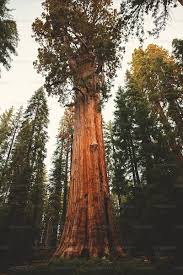
Read the facts about the General Sherman Tree below :
1. The World's Largest Single Organism: General Sherman holds the undisputed global title of being the largest living single-stem tree by total volume on Earth. Located in California's Sequoia National Park, its trunk volume ranks far higher than any other plant organism currently recorded. This immense physical scale means that the tree contains more total wood mass than can be found on several hectares of typical commercial timberland. Its columnar growth pattern ensures that it maintains a thick, heavy trunk high into the forest canopy, creating a truly formidable presence. This massive visual build makes visitors feel exceptionally small when walking up to the plant. However, maintaining such a massive trunk requires stable soil and specialized protection to prevent modern tourist foot traffic from compacting the earth around it.
2. High Trunk Volume: Unlike taller coastal redwoods, the General Sherman tree focuses its massive growth into a thick trunk with an estimated volume of 1,487 cubic meters. In traditional lumber terms, this singular plant contains enough wood material to construct approximately 120 average-sized family homes. The main trunk alone is incredibly dense and heavy, weighing nearly 1.2 million kilograms on its own. To help people visualize this immense plant scale, experts compare its total wood mass to 15 adult blue whales or 25 heavy military battle tanks. This unique reliance on a thick, single-stem structure establishes it as a true natural wonder of the botanical world.
3. Evergreen Botanical Species: The General Sherman tree belongs to the ancient giant sequoia species, known scientifically as Sequoiadendron giganteum. This cone-bearing evergreen features an iconic reddish-brown bark that sets it apart from adjacent white firs and pines. Giant sequoias are uniquely adapted to the distinct environmental pressures of the western slopes of California's Sierra Nevada mountain range. Their brittle wood quality historically deterred heavy commercial logging, which ultimately saved the specimen from early destruction. Today, this magnificent plant branch represents an important piece of global evolutionary history, heavily protected within a small network of natural groves.
4. Unbelievable Plant Height: The impressive physical frame of the General Sherman tree reaches approximately 83.8 meters straight up into the sky. This massive height is equivalent to a 25-story office building, towering over the surrounding mountain landscape. While it is not the absolute tallest tree species on the globe—a distinction held by coastal redwoods—its sheer combination of height and width is unmatched. Its high-altitude canopy features heavy branches, including a massive top branch that has a diameter of 2.2 meters. This vertical distribution ensures that the plant captures maximum sunlight to drive its daily food production.
5. Massive Base Circumference: At ground level, the General Sherman tree features an exceptionally wide base with a ground circumference measuring 31.3 meters. Its true base diameter exceeds 11.1 meters across, making it wide enough that it would take a large group of adults holding hands to completely surround the trunk. This heavy base flares outward to provide maximum structural support for the millions of kilograms of wood pressing down from above. This specialized anatomical shape ensures that the ancient tree remains firmly balanced against heavy mountain winds and winter snow packs.
6. Enormous Total Weight: The calculated total weight of this living organism is believed to reach an estimated 2.4 million kilograms. This makes General Sherman one of the heaviest living plant organisms ever measured by modern science. This massive weight is supported by a shallow but expansive root network that radiates outward from the flared base of the trunk. To ensure the heavy tree does not tilt or collapse, park rangers use fencing to keep visitors off the sensitive ground surrounding the roots.
7. Ancient Living Lifespan: A historical look at General Sherman reveals an incredible biological lifespan estimated between 2,300 and 2,700 years old. This means the giant tree originally emerged from a tiny seed well before the rise of the Roman Empire. It has successfully survived centuries of changing climates, seasonal droughts, and historical forest fires that claimed adjacent vegetation. This remarkable longevity highlights how perfectly adapted the species' natural biology is for surviving across thousands of years.
8. Continuous Annual Growth: Despite its ancient age, General Sherman is completely alive and continues to add new wood volume every single year. Each year, its active cambium layer deposits enough new wood ring tissue to equal the total size of a mature 18-meter-tall tree. This continuous growth behavior proves that giant sequoias do not stop developing as they grow older, provided they have access to water and sun. This cycle of annual wood production ensures that it expands its global volume lead over other plant specimens over time.
9. Native California Distribution: General Sherman is found in a highly specific geographic region, natively situated at the northern end of the Giant Forest grove. This grove is located within Sequoia National Park in Tulare County, California, sitting at a high elevation along the Sierra Nevada slopes. The tree thrives in this specific zone due to the unique combination of rich soil, seasonal snowmelt, and natural fire cycles. Unlike hidden height-record holders, its precise geographic location is open to the public, allowing millions of visitors to hike the paved access trail and view it up close.
10. Notable Branch Loss: In the winter of 2006, General Sherman experienced a dramatic structural event when a massive overhanging branch snapped off its upper trunk. The broken branch measured over 2.2 meters in diameter and smashed down through the protective pathways and fences below. While this loss slightly altered the tree's upper canopy shape, it did not change its official status as the world's largest tree by volume, since the title is calculated using the trunk's main bole. This event highlighted that even the strongest living plants face structural failures as they grow heavier.
11. High Fire Resistance: The primary secret behind General Sherman's multi-millennial survival is its highly unique, spongy bark, which can grow up to 0.61 meters thick. This thick outer hide contains no flammable resins or sap, serving as a highly effective, natural heat shield against intense forest fires. When a typical low-intensity fire sweeps through the grove, the bark charrs slightly but stops the intense heat from reaching the living cambium layer underneath. This evolutionary design ensures that the plant survives natural fire cycles that routinely clear out competing white fir trees.
12. Fire-Dependent Reproduction: Giant sequoias like General Sherman rely heavily on forest fires to complete their reproductive lifecycles. The tree produces thousands of tiny pinecones that hold minuscule seeds, which remain tightly sealed up in the canopy for years. When the heat of a forest fire rises, it dries out the cones, causing them to open and drop the seeds onto the newly cleared forest floor. The ash-rich soil and lack of competition from fire-sensitive plants give the new seedlings a strong chance of growing successfully.
13. Resistant Interior Heartwood: Inside the thick bark layer sits a specialized, dark wood known as heartwood, which provides the tree's core strength. This internal wood structure is packed with natural chemicals that make it highly resistant to fungal rot, boring insects, and decay. This chemical engineering ensures that even when a fire scar exposes the wood, the tree does not easily rot from the inside out. This defense system allows the plant frame to remain standing upright for thousands of years without structural collapse.
14. Historic Naming Disputes: The massive tree has a colorful historical background regarding its identity, having been named multiple times since its documentation. It was originally named in 1879 by pioneer James Wolverton, who served under Civil War General William Tecumseh Sherman. Later, a utopian socialist group known as the Kaweah Colony took control of the grove and briefly renamed the specimen the "Karl Marx Tree" from 1886 to 1892. After the colony dissolved, the US government officially re-established its original military name, which remains on park signs today.
15. Human Proximity Protection: Because General Sherman attracts thousands of tourists every week, the National Park Service must take aggressive measures to protect the tree from human impact. A sturdy wooden fence encircles the entire base of the tree to prevent visitors from walking over the soil. Giant sequoias possess exceptionally shallow root systems that spread out wide just beneath the dirt surface. If thousands of tourists step directly on this earth, the soil compacts, cutting off the roots' access to vital oxygen and moisture.
16. Modern Firefighting Intervention: In September 2021, General Sherman faced an unprecedented survival crisis when the severe KNP Complex Fire swept through Sequoia National Park. To protect the world's most massive tree from intense modern fuel loads, wildland firefighters took the extraordinary step of wrapping its lower trunk in a specialized, fire-resistant aluminum foil. This shiny protective blanket reflected radiant heat away from vulnerable base scars, ensuring the tree emerged from the disaster completely unharmed.
17. Natural Photoautotrophic Diet: As a member of the plant kingdom, General Sherman does not hunt or forage for organic food like animals. Instead, it relies on a photoautotrophic diet, utilizing its green foliage to absorb sunlight and convert carbon dioxide into sugars. Its vast roots draw thousands of liters of groundwater up into the canopy to support this continuous chemical synthesis. This self-sustaining system allows the massive plant to build millions of kilograms of wood purely out of water, air, and light over centuries.
18. Nearby Botanical Rivals: While General Sherman is the absolute largest single tree on Earth by volume, it shares its neighborhood with several other giant sequoias. The world's second-largest tree, named the General Grant Tree, is located not too far away within neighboring Kings Canyon National Park. These adjacent giants create an incredible forest cathedral effect that draws visitors from all over the world. Walking through these ancient groves offers a stark reminder of the sheer scale that flora can achieve under ideal preservation conditions.
19. Historical Lost Giants: Although General Sherman is the largest tree currently alive, historical records show that even larger plant giants once existed before modern protections were enacted. A coastal redwood known as the Crannell Creek Giant was estimated to be 15% to 25% larger than General Sherman by volume before it was cut down by commercial loggers in the mid-1940s. Another specimen, the Lindsey Creek tree, held over 2.5 million cubic decimeters of volume before a severe storm knocked it over in 1905. These lost records highlight how critical modern national parks are for preserving the remaining giants.
20. Severe Climate Threats: Despite its ancient resilience, General Sherman faces an uncertain future due to shifting global climate patterns and severe modern droughts. Rising temperatures in the Sierra Nevada mountains lead to decreased winter snowpacks, reducing the vital groundwater supply that sequoias rely on during hot summer months. Furthermore, decades of aggressive fire suppression have caused an unnatural buildup of dense underbrush, creating intense fires that can bypass the thick bark and destroy the canopy. Protecting General Sherman requires active forest management, including controlled prescribed burns, to ensure the living wonder continues growing for centuries to come.