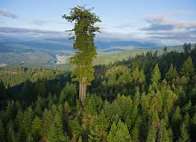
Read the facts about the Hyperion Tree below :
1. The World's Tallest Single Organism: Hyperion holds the undisputed global title of being the tallest living single-stem tree on Earth. Located deep within California's Redwood National Park, its physical height ranks far higher than any other plant organism currently recorded. This immense physical scale means that the tree stands taller than iconic global landmarks like Big Ben or the Statue of Liberty. Its exceptionally slender growth pattern ensures that it climbs straight into the forest canopy, creating a truly formidable presence. This massive vertical build makes visitors feel exceptionally small when conceptualizing the plant. However, maintaining such a massive height requires stable soil and specialized protection to prevent modern tourist foot traffic from compacting the earth around it.
2. High Trunk Volume: Unlike chunkier giant sequoias, the Hyperion tree focuses its massive growth into a towering height with an estimated trunk volume of 530 cubic meters. In traditional lumber terms, this singular plant contains enough wood material to construct approximately 35 average-sized five-room family homes. The main trunk alone supports an expansive crown containing over 550 million leaves. To help people visualize this immense plant scale, experts note it is operating near the absolute biological ceiling for tree growth, where water transport tubes struggle to defy gravity. This unique reliance on a hyper-extended, single-stem structure establishes it as a true natural wonder of the botanical world.
3. Evergreen Botanical Species: The Hyperion tree belongs to the ancient coast redwood species, known scientifically as Sequoia sempervirens. This cone-bearing evergreen features a highly fibrous bark that sets it apart from adjacent coastal vegetation. Coast redwoods are uniquely adapted to the distinct environmental pressures of the foggy valleys of Northern California's Pacific coast. Their habitat narrowly escaped heavy commercial clearcutting in the 1970s before Jimmy Carter's administration purchased the valley for federal protection. Today, this magnificent plant branch represents an important piece of global evolutionary history, heavily protected within a small network of natural groves.
4. Unbelievable Plant Height: The impressive physical frame of the Hyperion tree reaches approximately 116.22 meters straight up into the sky. This massive height is equivalent to a 35-story office building, towering over the surrounding valley landscape. While it is not the most massive tree species on the globe—a distinction held by giant sequoias—its sheer vertical reach is completely unmatched. Its high-altitude canopy features the deepest measured crown in the world, dipping 90.9 meters down the main body. This vertical distribution ensures that the plant captures maximum sunlight and atmospheric moisture to drive its daily food production.
5. Slender Base Circumference: At ground level, the Hyperion tree features an exceptionally slender base compared to its height, with a diameter measuring just 4.63 meters across. Its precise ground circumference is relatively narrow, allowing it to scale upward like a massive natural pillar. This column-like trunk lacks the extreme bottom flare of mountain trees but is anchored deeply into the valley floor. This specialized anatomical shape ensures that the ancient tree remains perfectly balanced against heavy Pacific winds and coastal storms.
6. Enormous Canopy Density: The calculated leafy mass of this living organism is believed to hold more than 550 million individual needles. This makes Hyperion one of the most structurally complex living plant crowns ever mapped by modern canopy researchers. This massive upper weight is supported by a shallow but expansive root network that radiates outward from the base of the trunk. To ensure the heavy tree does not tilt or suffer root rot, federal authorities closed off the surrounding forest to keep visitors off the sensitive ground surrounding the roots.
7. Ancient Living Lifespan: A historical look at Hyperion reveals an incredible biological lifespan estimated between 600 and 800 years old. This means the giant tree originally emerged from a tiny seed during the European Middle Ages, making it relatively young for its species. It has successfully survived centuries of changing climates, coastal winds, and historical logging booms that claimed adjacent vegetation. This remarkable longevity highlights how perfectly adapted the species' natural biology is for surviving across hundreds of years.
8. Continuous Annual Growth: Despite its immense height, Hyperion is completely alive and continues to grow taller every single year. Each year, its upper shoots expand upwards by an estimated 1.5 inches. This continuous growth behavior proves that coast redwoods do not stop developing as they grow older, provided they can pump water to their topmost branches. This cycle of annual height extension ensures that it maintains its global vertical lead over other plant specimens over time.
9. Native California Distribution: Hyperion is found in a highly specific geographic region, natively situated within Humboldt County in Northern California. This grove is located within Redwood National Park, sitting at an elevation of roughly 160 feet within the Redwood Creek basin. The tree thrives in this specific zone due to the unique combination of rich alluvial soil, dense coastal fog, and heavy seasonal rainfall. Unlike popular tourist landmarks, its precise geographic coordinates are kept strictly secret to protect the fragile ecosystem from foot traffic.
10. Notable Top Damage: In the upper canopy, Hyperion has experienced notable physical changes, including damage to its topmost crown caused by woodpeckers. This avian activity has slightly slowed its vertical ascent at the absolute peak. While this top wear slightly alters the tree's final profile, it has not stopped its reign as the world's tallest tree. This event highlighted that even the highest living plants face natural biological pressures and damage far above the forest floor.
11. High Fire Resistance: The primary secret behind Hyperion's multi-century survival is its highly unique bark, which can grow up to 12 inches thick. This fibrous outer hide is rich in protective tannins and contains no flammable resins, serving as an effective natural shield. When a low-intensity fire sweeps through the redwood basin, the bark chars but stops the intense heat from killing the living cambium layer underneath. This evolutionary design ensures that the plant survives natural fire cycles that clear out competing vegetation.
12. Fire-Dependent Reproduction: Coast redwoods like Hyperion rely heavily on forest disturbances and fires to facilitate healthy reproductive cycles. The species produces small cones holding minuscule seeds, but it also possesses a remarkable ability to regenerate directly via cloning. When a fire or injury damages the main trunk, dormant buds under the bark are activated, sprouting new burls around the base. This ensures that even if the primary crown faces disaster, the tree's genetic lineage continues to rise from the ash-rich soil.
13. Resistant Interior Heartwood: Inside the thick bark layer sits a highly specialized, dense red wood known as heartwood, which provides the tree's core strength. This internal wood structure is heavily saturated with organic chemical compounds that make it highly toxic to wood-boring insects and fungi. This chemical engineering ensures that even when a deep crack exposes the interior, the tree does not easily rot from the inside out. This defense system allows the towering frame to remain standing straight for thousands of years without structural collapse.
14. Historic Naming Origin: The massive tree has a colorful mythological background regarding its identity, having been named after a figure from ancient Greek lore. It was named Hyperion after the primordial Titan god of heavenly light and observation. Discovered alongside other record-breaking giants in the same basin, it shares its neighborhood with trees named Helios (the sun god) and Icarus. This celestial naming theme reflects the awe experienced by the naturalists who first measured its unbelievable reach toward the sky.
15. Human Proximity Protection: Because Hyperion's discovery generated immense public interest, the National Park Service had to take aggressive measures to protect the tree from human impact. Unlike other accessible giants, a strict closure zone encircles the entire surrounding valley. Coast redwoods possess exceptionally shallow, interconnected root systems that spread out wide just beneath the dirt surface. If crowds of tourists step directly on this earth, the soil compacts, trampling the roots and cutting off the tree's access to vital oxygen and moisture.
16. Modern Legal Intervention: In 2022, Hyperion faced a severe survival crisis due to an influx of off-trail hikers, bloggers, and bushwhackers damaging the base vegetation. To protect the world's tallest tree from habitat degradation, park officials took the extraordinary step of closing the entire area under federal code enforcement. Anyone caught trespassing in the restricted zone faces severe criminal penalties, including a $5,000 fine and up to six months in jail. This legal barrier reflects how vital absolute isolation is for preserving the tree's structural health.
17. Natural Photoautotrophic Diet: As a member of the plant kingdom, Hyperion does not hunt or forage for organic food like animals. Instead, it relies on a photoautotrophic diet, utilizing its 550 million green leaves to absorb sunlight and convert carbon dioxide into sugars. Its vast root system works in tandem with the canopy, absorbing up to 40% of its total water needs from the dense marine fog that rolls in from the Pacific Ocean. This self-sustaining system allows the massive plant to build hundreds of cubic meters of wood purely out of water, fog, and light over centuries.
18. Nearby Botanical Rivals: While Hyperion is the absolute tallest single tree on Earth by height, it shares its neighborhood with several other massive redwoods. The world's second-tallest tree, named Helios, stands just a short distance away within the same National Park boundaries. Other adjacent giants like Icarus create an incredible, hidden forest cathedral effect that defines the ancient old-growth basin. Knowing these adjacent giants exist helps scientists study how local microclimates support such extreme vertical growth.
19. Historical Lost Giants: Although Hyperion is the tallest tree currently alive, historical records show that even taller plant giants may have existed before modern protections were enacted. Intensive commercial logging in the 19th and 20th centuries wiped out over 96% of the world's original, ancient old-growth redwood forests. Historical accounts claim that cut-down specimens like the Lindsey Creek tree or the Crannell Creek Giant possessed staggering heights and volumes that might have eclipsed today's record holders. These lost records highlight how critical modern national parks are for preserving the remaining giants.
20. Severe Climate Threats: Despite its ancient resilience, Hyperion faces an uncertain future due to shifting global climate patterns and severe modern droughts. Rising coastal temperatures lead to decreased seasonal fog frequency, reducing the vital atmospheric moisture supply that redwoods rely on during hot summer months. Furthermore, prolonged droughts dry out the upper canopy, increasing the risk of wind snaps at the very top of its fragile frame. Protecting Hyperion requires aggressive ecosystem conservation to ensure the living wonder continues scaling the skies for centuries to come.