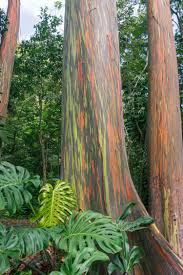
Read the facts about the Rainbow Eucalyptus Tree below :
1. The World's Most Colorful Tree: The Rainbow Eucalyptus holds a celebrated global title as the most visually vibrant tree species on the planet. Indigenous to tropical environments across Southeast Asia, its bark resembles an evolving, abstract canvas of hyper-saturated tones. This spectacular color play makes the tree highly popular in botanical circles and ornamental landscaping worldwide. Walking into a grove of these trees offers a striking visual experience, with trunks displaying vertical ribbons of neon green, deep crimson, and violet. However, achieving this stunning coloration requires a specific environment featuring rich soil, abundant moisture, and intense, direct sunlight.
2. Rapid Growth Rates: Unlike slow-growing temperate giants, the Rainbow Eucalyptus channels its biological energy into lightning-fast vertical development. It is celebrated as one of the fastest-growing trees in the botanical world, regularly adding 3 to 5 feet of height in a single season under ideal conditions. In fact, young specimens have been documented growing an astounding 10 meters tall in just 18 months. This rapid growth rate makes it a highly valuable resource for commercial forestry, allowing timber plantations to harvest sustainable wood pulp far quicker than standard tree varieties.
3. Unique Rainforest Eucalyptus: The Rainbow Eucalyptus belongs to the Myrtaceae family and carries the botanical name Eucalyptus deglupta. It holds a distinct evolutionary honor as the only eucalyptus species that natively populates wet tropical rainforests rather than arid landscapes. Furthermore, it is the sole member of its extensive genus whose natural geographic range crosses the equator into the Northern Hemisphere. While its leaves carry an unmistakably pleasant aroma, they contain a significantly lower concentration of volatile oils compared to their Australian cousins.
4. Towering Tropical Height: The impressive physical architecture of a wild Rainbow Eucalyptus allows it to pierce through dense tropical forest canopies. In its native habitats, mature specimens regularly scale heights between 60 and 75 meters tall. This immense vertical reach places it among the tallest trees in the rainforest ecosystem, where it provides vital nesting space for high-altitude bird species. To capture the solar energy required to fuel this rapid climb, its high canopy spreads out wide with lance-shaped, evergreen foliage.
5. Sturdy Trunk and Buttresses: At ground level, the Rainbow Eucalyptus anchors its massive vertical frame using a heavily structured trunk that can grow up to 2.4 meters in diameter. Because it grows in soft, saturated rainforest soils, the tree cannot rely on deep taproots alone to remain upright. Instead, it flares outward at the base, developing large, wing-like buttress roots that can stand up to 4 meters high. This evolutionary adaptation distributes the tree's weight outward, providing structural stabilization against powerful tropical storms and high winds.
6. Commercial Pulp Value: While admired for its beauty, the timber harvested from Eucalyptus deglupta plays an important role in international trade. The wood possesses excellent structural properties that make it a premier choice for industrial paper and pulp production across tropical zones. Because the species propagates easily from cuttings and possesses an exceptional growth rate, it is widely grown on commercial plantations. This sustainable plantation farming helps alleviate logging pressures on native, old-growth rainforest trees.
7. Shorter Biological Lifespan: A historical look at the life cycle of the Rainbow Eucalyptus reveals a brief but highly explosive biological lifespan compared to ancient conifers. Rather than living for thousands of years, a typical specimen lives for a modest 50 to 150 years before succumbing to natural forest turnover. Because it grows so rapidly, its wood can be relatively brittle, making older trees susceptible to structural failure or heart rot over time. This shorter lifecycle fits perfectly within the fast-paced, high-turnover dynamics of a tropical rainforest ecosystem.
8. Continuous Bark Shedding: The mesmerizing coloration of the Rainbow Eucalyptus is driven by a continuous, seasonal shedding cycle. As the tree expands, it peels away its outer bark in long, thin vertical strips at irregular intervals throughout the year. This peeling behavior serves an ecological purpose, preventing parasitic vines and epiphytes from choking the trunk. The shedding process ensures that the tree's exterior is constantly renewing itself, preventing the buildup of thick, dead bark layers seen on temperate trees.
9. Native Island Distribution: The Rainbow Eucalyptus thrives natively in a highly specific equatorial zone, hailing from the rainforests of the Philippines, Indonesia, and Papua New Guinea. It is particularly famous on the southern Philippine island of Mindanao, earning it the common alternative moniker of "Mindanao Gum". The species thrives in lowland maritime environments from sea level up to altitudes of 1,800 meters. Within these native islands, the tree relies on stable, warm temperatures and consistent, year-round rainfall to maintain its vivid coloration.
10. Shifting Color Palette: The precise mechanism behind the tree's artistry relies on the chemical maturation of its exposed tissue. When a strip of bark first falls away, it reveals a raw, inner cambium layer that shines with a brilliant neon green. Over time, exposure to air and sunlight causes this tissue to darken, changing sequentially into deep blues, purples, and grays. As the cells age further, they transform into warm shades of yellow, orange, and copper before turning brown and peeling away to restart the cycle.
11. Low Frost Tolerance: The primary geographic constraint limiting the spread of the Rainbow Eucalyptus is its extreme sensitivity to cold weather. While it can tolerate brief chilly spells, prolonged exposure to frost or sub-freezing temperatures will severely damage or kill the tree. Because of this tropical requirement, it can only grow outdoors in the warmest global regions, corresponding to USDA Hardiness Zones 9b through 11. In colder climates, enthusiasts must grow it in heavily climate-controlled greenhouses or scale it down as an indoor bonsai.
12. Tiny Ant-Sized Seeds: Despite growing into an absolute giant of the rainforest, the Rainbow Eucalyptus begins its life from an incredibly minuscule seed. The seeds are so small and lightweight that they are comparable in size to a tiny ant, requiring careful handling during propagation. In nature, these lightweight seeds are dispersed by wind and water across the damp forest floor. Because they lack a large internal energy reserve, the seeds demand highly specific, warm conditions between 80-85°F to successfully sprout.
13. Traditional Medicinal Uses: Beyond its visual and industrial value, the Rainbow Eucalyptus holds a significant place in traditional regional medicine. The lance-shaped leaves are rich in natural phytochemicals that offer excellent antiseptic and anti-inflammatory benefits. Indigenous communities historically crushed the leaves to create aromatic poultices for cleaning wounds or alleviating respiratory distress like asthma and coughs. Additionally, the subtle herbal fragrance emitted by the crushed foliage serves as a natural repellent against mosquitoes.
14. Global Introduction: Because of its undeniable aesthetic appeal and fast growth, humans have introduced the Rainbow Eucalyptus far beyond its native island homes. Today, thriving populations can be found in tropical regions of Hawaii, Costa Rica, Brazil, and parts of Africa. In places like Hawaii's Dole Plantation, rows of these multi-colored giants have become major eco-tourism destinations. However, conservationists must carefully manage these introduced populations, as the tree's aggressive growth can sometimes outcompete sensitive native flora.
15. Soil Stabilization Benefits: In addition to commercial forestry, the Rainbow Eucalyptus provides exceptional ecological services regarding soil conservation. Thanks to its expansive, rapid-growing root systems, the tree is frequently planted along vulnerable riverbanks and deforested hillsides to prevent erosion. Its roots bind loose tropical soils tightly together, mitigating the devastating landslides that often follow severe monsoon rains. This specialized root structure allows devastated landscapes to recover structural integrity while providing a habitat for local wildlife.
16. High Water Demands: Maintaining the rapid metabolic rate of Eucalyptus deglupta requires a massive, consistent supply of water. The species thrives in areas without a pronounced dry season, drawing immense amounts of moisture from the earth daily to support its lush foliage. When cultivated in drier regions, like the deserts of Arizona, growers must provide heavy, deep irrigation to keep the plant from wilting. This intense thirst means it should not be planted near delicate plumbing systems, as its roots will aggressively seek out moisture leaks.
17. Fluffy White Blossoms: During its extended summer and autumn blooming seasons, the Rainbow Eucalyptus transforms its upper canopy with delicate flowers. The tree produces clusters of small white-to-pale-yellow blossoms that lack traditional petals. Instead, the flowers are composed of numerous long, fluffy stamens that give them a distinctive spiky or feathery appearance. These consistent blossoms are highly rich in nectar, making the tree an exceptional attractor for local honeybees, hummingbirds, and tropical pollinators.
18. Domestic Animal Toxicity: Despite its ecological benefits and beautiful appearance, property owners must exercise caution when planting the tree near livestock or pets. The bark, leaves, and concentrated essential oils of the Rainbow Eucalyptus contain compounds that are highly toxic to dogs, cats, and horses. If ingested, these plant parts can induce severe gastrointestinal distress, weakness, and neurological symptoms in domestic animals. As a result, veterinary experts recommend keeping these ornamental trees fenced off or entirely away from active pastures and pet areas.
19. Wild Vulnerability Status: While millions of Rainbow Eucalyptus trees thrive on commercial timber plantations globally, their wild, old-growth populations face an alarming crisis. The International Union for Conservation of Nature (IUCN) officially classifies the wild species as "Vulnerable". This designation stems from a devastating 30% decline in native rainforest populations over the last two centuries. The primary drivers behind this loss include unregulated logging, agricultural land clearing, and the destruction of native equatorial rainforests.
20. Climate Change Challenges: Shifting global weather patterns present an increasingly unpredictable challenge for the future of wild Rainbow Eucalyptus groves. Because the species is entirely dependent on a stable, wet tropical rainforest climate, any alteration in seasonal monsoons can disrupt its growth. Rising global temperatures are leading to prolonged dry spells and unseasonal droughts in equatorial regions, drying out the humid soil the trees rely on. Protecting the remaining wild populations requires strict international habitat preservation to ensure this living work of art survives in nature.