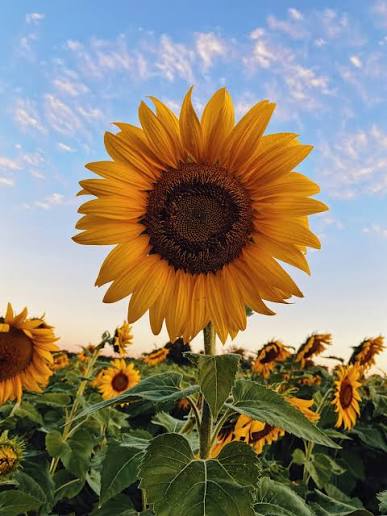
Read the facts about the sunflower below :
1. Solar Tracking Masters: Sunflowers hold a highly unique global reputation due to a specialized biological behavior known as heliotropism. Young plants follow the trajectory of the sun from east to west every day to maximize their sun exposure. This immense physical adaptation means that the plant optimizes its energy intake during its most rapid growth phases. Its dynamic mechanical stem structure ensures that it bends smoothly without snapping, using a built-in circadian rhythm to reset its position back to the east overnight. This macro visual display makes fields of young sunflowers look completely uniform and coordinated to onlookers. However, maintaining this continuous movement requires flexible cell walls and specific internal fluid pressures that adjust dynamically as the sun moves across the sky.
2. Thousands of Tiny Blossoms: Unlike simple single flowers, a sunflower head focuses its massive reproductive growth into a complex structure containing thousands of individual florets. In botanical terms, this singular head contains an Outer Ring of bright ray florets and an Inner Disk packed with fertile disc florets. The main disk alone is incredibly structured, arranging its blossoms in an intricate pattern of intersecting spirals. To help people visualize this unique geometric build, scientists point out that the arrangement follows the mathematical Fibonacci sequence perfectly. This unique reliance on a dense, composite layout establishes it as a true natural wonder of the evolutionary botanical world.
3. Dynamic Botanical Species: The common sunflower belongs to the highly successful Asteraceae family, known scientifically as Helianthus annuus. This seed-bearing annual features an iconic bright yellow bloom that sets it apart from adjacent agricultural crops and wild grasses. Sunflowers are uniquely adapted to the distinct environmental pressures of open, sun-drenched plains and hot summer growing seasons. Their resilient seed quality historically encouraged early human cultivation, which ultimately spread the specimen from North America into global trade networks. Today, this magnificent plant branch represents an important piece of global agricultural history, heavily cultivated within millions of hectares worldwide.
4. Unbelievable Plant Height: The impressive physical frame of the sunflower reaches an average height of 2 to 3 meters straight up into the sky. This rapid height is achieved in just a few months, towering over most other seasonal backyard vegetation. While it is not the absolute tallest plant on the globe—a distinction held by perennial trees—its sheer velocity of vertical growth is unmatched. Its high-altitude crown features broad, coarse leaves, including a massive flower head that can expand significantly in size. This vertical distribution ensures that the plant captures maximum sunlight to drive its daily food production.
5. Massive Bloom Circumference: At the peak of its growth, the giant sunflower features an exceptionally wide flower face with a circumference measuring up to 90 centimeters. Its true head diameter can exceed 30 centimeters across, making it wide enough that it completely dominates the garden landscape. This heavy head droops downward at maturity to provide maximum protection for the thousands of ripening seeds pressing forward from the center. This specialized anatomical shape ensures that the annual plant sheds heavy autumn rainwater and avoids rotting before its lifecycle concludes.
6. Enormous Oil and Seed Weight: The calculated total seed yield of a mature sunflower head is believed to reach an estimated 2,000 seeds per plant. This makes the sunflower one of the most productive oilseed organisms ever measured by modern agricultural science. This massive seed weight is supported by a single, tough stalk that hardens into a wood-like fiber as the season progresses. To ensure the heavy flower head does not snap the stem, commercial growers select varieties with robust, fibrous stalks that can handle the shifting weight.
7. Brief Annual Lifespan: A historical look at the sunflower reveals an intense biological lifespan restricted between 80 and 120 days total. This means the giant annual emerges from a tiny seed, shoots up multiple meters, blooms, and dies well within a single summer season. It has successfully adapted to utilizing short windows of warm weather, seasonal rains, and intense summer sun to outgrow surrounding competitive weeds. This remarkable speed highlights how perfectly adapted the species' natural biology is for generating maximum offspring across a very brief timeframe.
8. Continuous Daily Growth: Despite its brief lifespan, the sunflower is highly active and continues to add new cell tissue every single day of its vegetative cycle. Each week, its active vascular system deposits enough new fibrous material to increase its height by several centimeters. This continuous growth behavior proves that annual plants utilize a hyper-efficient metabolism to reach maturity before the first frost arrives. This cycle of rapid biomass production ensures that it secures its access to light over lower-lying plant specimens in the field.
9. Global Agricultural Distribution: The sunflower is found in diverse geographic regions, natively situated across the open plains of North America. However, it thrives globally today due to its adaptability to rich soils, temperate climates, and modern agricultural practices. The plant grows exceptionally well in commercial belts across Europe and South America, where millions of hectares are harvested annually. Unlike rare or endangered flora, its precise geographic fields are expansive and open, providing scenic landscapes that draw photographers and tourists every summer.
10. Notable Facing Shift: Upon reaching full maturity, the sunflower experiences a dramatic behavioral event when its tracking movement completely stops. The mature flower head locks into place and permanently faces due east rather than moving with the daily sun. While this loss of movement changes the plant's dynamic nature, it provides a distinct advantage by keeping the flower face warm in the early morning. This event highlights that even the most active tracking plants transition into static structures once their primary reproductive phase begins.
11. High Environmental Resilience: The primary secret behind the sunflower's widespread global success is its highly unique, coarse stem, which features protective bristly hairs. This rough outer hide protects the inner vascular system from drying out, serving as a highly effective, natural defense against hot winds. When a typical summer drought hits the region, the plant utilizes its deep root system to pull moisture from deep underground layers. This evolutionary design ensures that the plant survives intense seasonal heat waves that easily wither shallow-rooted garden flora.
12. Soil-Cleansing Power: Sunflowers are highly valued for a unique ecological process known as phytoremediation, which cleans up polluted environments. The plant produces an extensive root network that aggressively absorbs heavy metals, nuclear radiation, and toxins directly from the soil. When planted in contaminated zones, they store these dangerous components safely within their fast-growing stalks and leaves. The success of this organic extraction method was proven on a massive scale following ecological disasters at Chernobyl and Fukushima, where fields of sunflowers were deployed to restore the earth.
13. Resistant Fibrous Inner Core: Inside the rough outer stem sits a specialized, pithy core known as the vascular bundle system, which provides the plant's structural integrity. This internal stalk structure is packed with cellulose fibers that make it highly resistant to bending under the weight of the massive flower. This cellular engineering ensures that even when heavy winds buffeted the fields, the plant does not easily fold over or break in half. This defense system allows the tall frame to remain standing upright through late-summer storms until the seeds are fully harvested.
14. Historic Cultural Migration: The versatile sunflower has a colorful historical background regarding its journey around the world since its initial documentation. It was originally cultivated by Indigenous North American tribes as a vital source of food, oil, and purple textile dye. Later, Spanish explorers took the unique seeds back to Europe, where the plant eventually caught the attention of Russian rulers in the 18th century. After massive breeding programs increased the oil content of the seeds, the plant emerged as a global agricultural staple, returning to the Americas as a major commercial crop.
15. Bird and Wildlife Interdependence: Because the sunflower produces thousands of oil-rich seeds, it acts as a primary ecological anchor for local wildlife populations. A sturdy stand of mature sunflowers attracts an array of songbirds, small mammals, and beneficial insects to the garden. The plants possess an open, accessible face that makes it easy for foraging animals to harvest the high-energy seeds. If wild birds visit these stalks regularly, they help scatter the seeds naturally across the landscape, assisting the plant in establishing new wild colonies the following spring.
16. Modern Spaceflight Experiments: In recent scientific history, the sunflower faced a unique environmental test when its seeds were launched into orbit for space exploration research. To observe how complex tracking plants handle zero gravity, astronauts grew sunflower specimens aboard international space stations. This unique botanical experiment confirmed that even without a traditional horizon, the seedlings utilized artificial light sources to direct their growth successfully.
17. Natural Allelopathic Properties: As a competitive member of the plant kingdom, the sunflower does not rely solely on height to dominate its territory. Instead, it utilizes an allelopathic defense system, releasing natural chemical compounds from its roots and leaves into the surrounding soil. This chemical distribution discourages the germination and growth of competing weed species within its immediate root zone. This self-protecting system allows the sunflower to secure exclusive access to local water and soil nutrients, ensuring its rapid development is unhindered.
18. Nearby Color Variations: While the classic bright yellow sunflower is the absolute standard worldwide, it shares its genetic family with spectacular color mutations. The world's alternative varieties feature deep crimson, chocolate brown, and multi-colored velvet petals that create striking visual displays. These adjacent color variants create an incredible aesthetic diversity that draws plant breeders and home gardeners alike. Walking through these multi-colored fields offers a stark reminder of the sheer genetic versatility that a single flower species can achieve.
19. Historical Wild Ancestors: Although modern agricultural sunflowers produce massive single heads, historical records show that original wild varieties looked vastly different before human breeding began. A typical wild sunflower features a highly branched habit, producing dozens of miniature flower heads instead of one single giant bloom. These ancestral variants held small, hard seeds that prioritized survival over oil production before indigenous farmers selected for a single-stem trait. These evolutionary records highlight how critical human agricultural history is to the development of the modern crop.
20. Severe Climate Adaptation: Despite its natural resilience, the sunflower faces an changing future due to global shifts in seasonal rainfall and extreme weather events. Rising temperatures in primary agricultural belts can lead to rapid soil drying, reducing the critical moisture required during the crucial seed-filling stage. Furthermore, modern monoculture farming introduces risks of widespread pest outbreaks, requiring active ecological management, including crop rotation and companion planting. Protecting sunflower genetic diversity ensures this vital agricultural wonder continues providing food and oil for generations to come.